

Long before hands, feet, or even a proper brain existed, something on the ancient seafloor already had a favourite side. Scientists studying the fossils of Spriggina floundersi, a strange, ribbon-bodied creature that lived roughly 550 million years ago during the Ediacaran Period, have found it consistently preferred to bend to the right, making it the oldest known animal to display population-wide handedness.
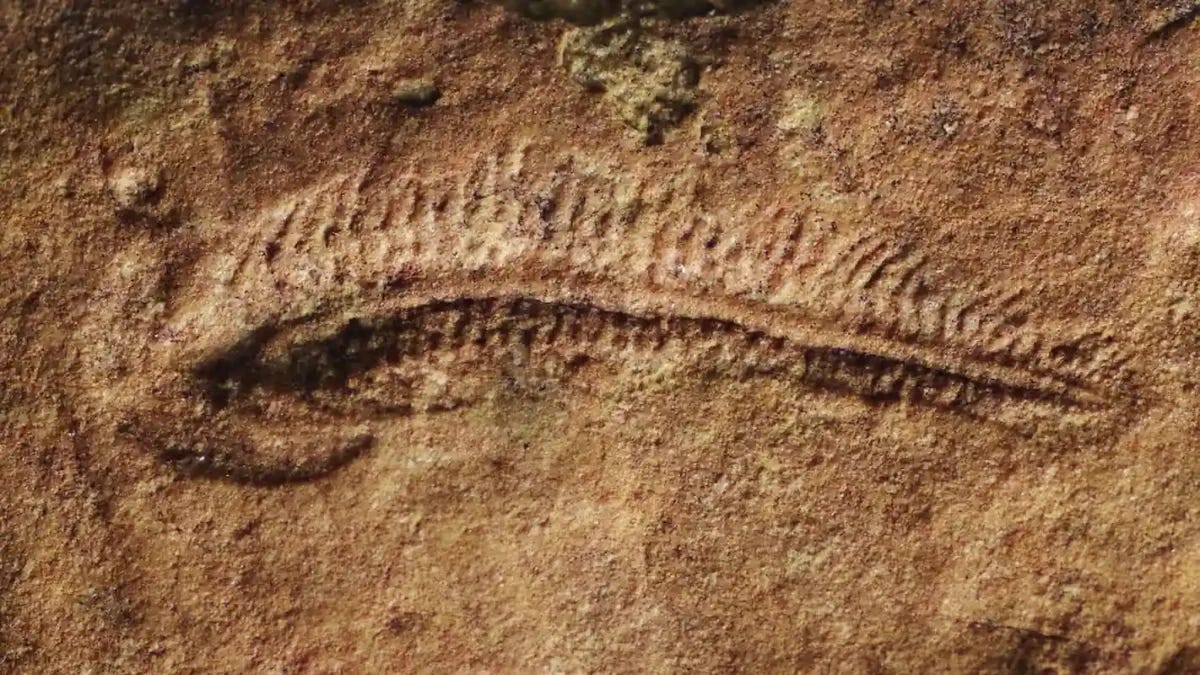
Fossils of Spriggina floundersi from South Australia preserve mirror-image impressions of the original animals. As a result, a leftward bend in the fossilized rock records an animal that actually bent to the right in life. Credit: Scott Evans / AMNH
The research, published in the journal Scientific Reports, was led by scientists at the American Museum of Natural History, together with colleagues from Florida State University, Harvard University, and the University of California, Riverside. The findings offer a rare window into just how far back in evolutionary history left-right behavioral preferences actually reach.
More than a matter of holding a pencil
Lead author Scott Evans, assistant curator of invertebrate paleontology at the American Museum of Natural History, put the discovery in accessible terms. When people talk about being right or left handed, he said, most probably think about which hand holds a pencil or which foot kicks a soccer ball. Yet the research shows that an animal with no hands and no feet at all, living more than 500 million years ago, may have had its own version of handedness all the same.
Spriggina lived during the Ediacaran Period, spanning roughly 635 to 538 million years ago, one of the most transformative stretches in the entire history of life on Earth. It was during this period that microscopic organisms first evolved into multicellular life large enough to see with the naked eye, and eventually capable of increasingly complex behavior, movement among them.
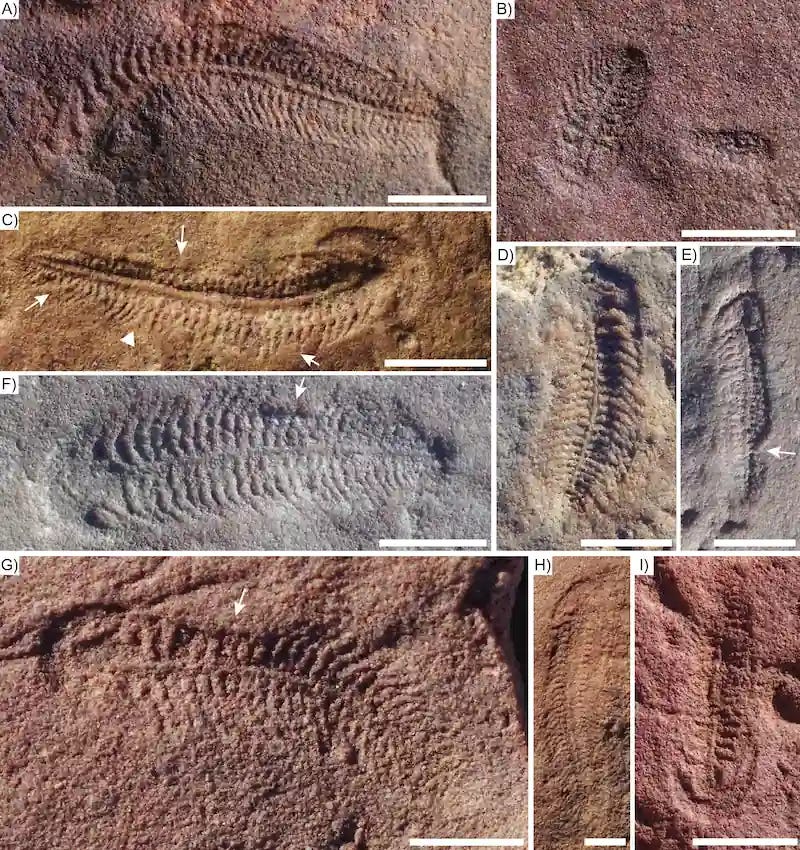
Fossils of Spriggina floundersi from South Australia. White arrows indicate regions of relief produced by lifting of the fossil surface, and the white triangle denotes the divergent bend angle between adjacent body modules. Credit: S.D. Evans et al. 2026
Fossils frozen mid-storm in the Australian outback
The Flinders Ranges of South Australia preserve one of the most extraordinary fossil records from this period anywhere on Earth. At Nilpena Ediacara National Park in particular, individual excavated beds capture entire communities of the Ediacara biota exactly as they were buried during ancient storm events, effectively freezing snapshots of the seafloor as it existed 550 million years ago.
Spriggina is among the most significant fossils recovered there, ranking as one of the earliest known animals with bilateral symmetry, a body plan with a distinct front and back, left and right sides, and top and bottom, the same basic organization shared by humans and the overwhelming majority of animals alive today. Spriggina holds the distinction of being the official state fossil of South Australia, and takes its name from Reg Sprigg, the geologist who first recognized the Ediacara biota in the Australian outback more than seventy-five years ago.
Twice as many fossils bent one way
To test whether Spriggina showed any real left-right preference in life, the research team examined shape variation across more than 100 exceptionally well-preserved fossils, drawn both from the beds at Nilpena and from the collections of the South Australia Museum in Adelaide.
The pattern that emerged surprised the researchers. Roughly twice as many fossil specimens appeared bent to the left as appeared bent to the right. Because these particular fossils preserve mirror-image impressions of the original living animals, that apparent leftward bend in the rock actually represents an animal that bent to the right while it was alive. The consistency of that pattern across so many individual fossils points to a genuine, population-wide behavioral preference, not simple chance variation.
What handedness might say about an ancient nervous system
Study co-author Mary Droser, a paleontologist at the University of California, Riverside, framed the discovery’s broader significance simply. It serves as a reminder, she said, that some of the traits people take for granted today have remarkably ancient origins.
The finding also offers researchers a new clue about how Spriggina may have experienced its world. As Evans explained, living animals that display this kind of handedness today, a group spanning insects, octopuses, birds, and mammals, tend to have genuinely complex sensory abilities. That comparison suggests Spriggina’s nervous system may have been considerably more sophisticated than its simple, ribbon-like body might otherwise suggest, and closer in complexity to the nervous systems of animals living today than previously assumed.
The study’s additional authors include Jenson Webb of Florida State University and the Florida Department of Environmental Protection, Ian V. Hughes of Harvard University, and William Parker of Florida State University. The research was supported in part by a NASA Exobiology grant.
Source. American Museum of Natural History (July 9, 2026). Evans, S.D., Webb, J., Hughes, I.V., et al. (2026). “Earliest Evidence of Behavioural Handedness in the Ediacaran Motile Bilaterian Spriggina floundersi.” Scientific Reports 16, 19924. doi.org/10.1038/s41598-026-53857-x