

Determining the sex of a fossil animal is one of palaeontology's more stubborn problems. Bones rarely say much about it, and the soft tissues that would settle the question almost never survive. A newly described gecko preserved in amber from Myanmar has now supplied a rare exception, a small swelling at the base of its tail that appears to mark it as male, making it among the oldest fossil lizards that can be confidently sexed.
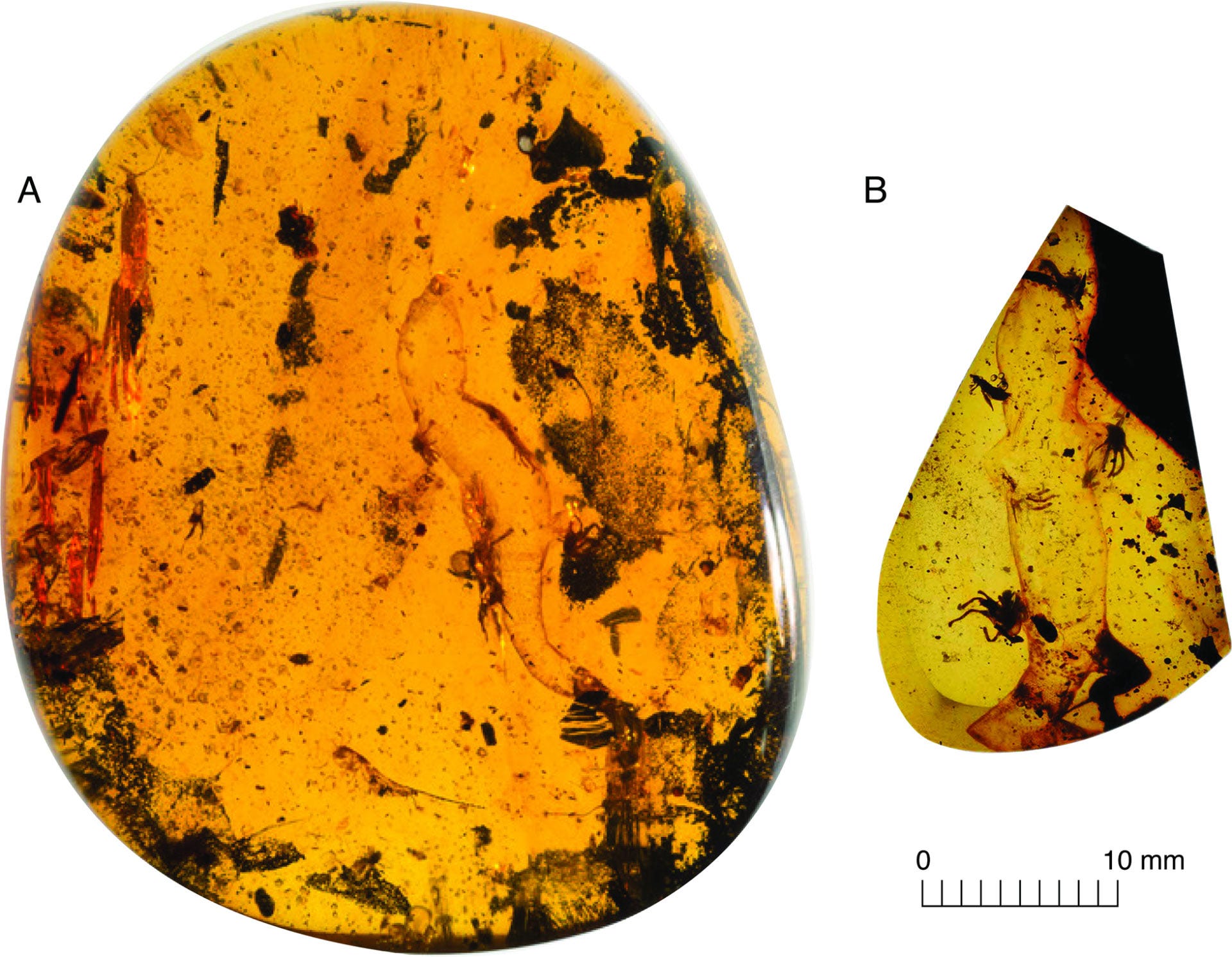
The animal has been named Carinasquama rusmithii, a new genus and species described from two pieces of amber recovered from the mid-Cretaceous deposits of Kachin State, Myanmar, dated to roughly 99 million years ago. The study, led by paleontologist Juan Daza of Sam Houston State University, was published in the Swiss Journal of Palaeontology.
Small enough to sit on a fingernail
The gecko itself was tiny, measuring between 1.6 and 2.2 centimeters from snout to vent, a size comparable to some of the smallest geckos alive today. It lived in the tropical forests that covered this region during the mid-Cretaceous, an environment whose resin trapped an extraordinary range of small animals and preserved them in three dimensions.
What survives of these two specimens is unusual in form. The bodies themselves have largely decayed away, leaving hollow voids inside the amber, but the outer covering endured in exceptional detail, individual scales, skin texture, and even the outline of the cloaca. To reconstruct what remained, the researchers scanned both specimens using micro-CT technology.
The bulge at the base of the tail
The find’s significance rests on one feature. On one of the two specimens, a swelling sits at the base of the tail, which Daza and colleagues interpret as a hemipenal bulge, the external sign of hemipenes, the paired copulatory organs carried by male squamates, the group comprising lizards and snakes. In living species, these organs sit retracted inside the base of the tail, producing a visible thickening in males.
The researchers laid out plainly why this matters. Paleontologists normally use skeletal features to determine the sex of fossil specimens, they noted, but incomplete remains make that difficult. Sexual dimorphism sometimes shows up as ornamentation, or can occasionally be teased out through statistical analysis of many specimens. Sex can also be inferred when eggs or embryos are found inside or alongside a specimen. Beyond that, sex-specific traits are rarely preserved at all. Hemipenal bulges are externally visible in living male squamates, but as the team put it, such structures typically leave no trace in rock fossils, though they may be preserved in amber.
That makes this specimen, in the authors’ own assessment, one of the oldest fossil lizards that can be unequivocally identified as male. The bulge also documents that hemipenes were already present in squamates by the mid-Cretaceous, though the researchers suspect the structures originated considerably earlier, probably alongside the group itself.
Where it fits on the family tree
Classifying the animal proved harder than sexing it. Carinasquama rusmithii shares a set of features with living gekkotans, including the absence of frontal and frontoparietal scales, small granular and uniform head scales, fused eyelids, body scales of relatively consistent size, and visible interstitial skin between the scales. Its precise position within the gecko family tree, however, remains unresolved, and the team has provisionally placed it within Pan-Gekkota, the broader group encompassing geckos and their close relatives.
A note on where the amber comes from
Fossils from Kachin amber carry a complication that has drawn sustained attention from the paleontological community. The deposits lie in a conflict-affected region of northern Myanmar, and the amber trade there has been linked to the financing of armed groups, prompting formal calls within the field, including from the Society of Vertebrate Paleontology, for researchers to exercise caution over specimen provenance and to avoid material extracted after the escalation of hostilities in 2017. The scientific value of these fossils is genuine and considerable, since amber preserves detail that rock almost never does, and this new gecko is a case in point. The circumstances of their extraction remain an open question the discipline continues to work through, and one worth keeping in view alongside the science itself.
Sources. Sci.News (July 20, 2026). Daza, J.D., et al. (2026). “Evidence of Male Anatomy in a Mid-Cretaceous Burmese Miniaturised Amber Gecko.” Swiss Journal of Palaeontology 145, 785 to 799. doi.org/10.3897/sjp.145.188227