

Around 120 million years ago, in the lakeside forests of what is now northwestern China, a small feathered predator may have glided between the branches like a flying squirrel, snatching some of the Cretaceous world's earliest birds out of the air.
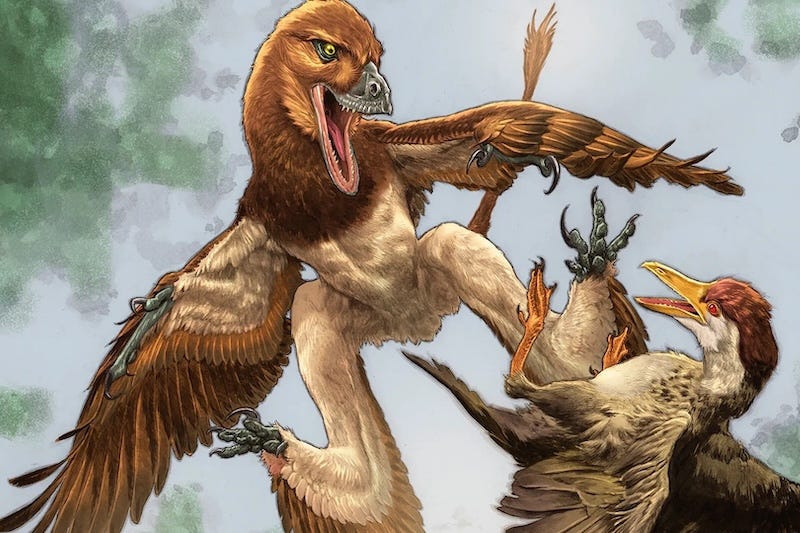
Illustration depicting Jian changmaensis (left) attacking the bird Gansus yumenensis (right) in the Changma Basin of northwestern China, approximately 120 million years ago. Credit: Illustration by Lewis LaRosa, colorized by Jão Canola.
The newly described dinosaur, named Jian changmaensis, was a close relative of Velociraptor and belonged to the microraptorines, a strange group of small, bird-like dinosaurs that looked nothing like the scaled, oversized raptors of popular imagination. Fossil evidence shows it carried long feathers on both its arms and its legs, giving the animal the look of a tiny, four-winged dragon.
The find is described in a paper by Zhou, L.Q., Lamanna, M.C., Poust, A.W., Li, D.Q., You, H.L., and O’Connor, J.K., published in the Annals of Carnegie Museum, and reported by Live Science on July 5, 2026.
A single fossil in a field full of birds
The fossil itself is modest, just a partial left shoulder and forelimb. But those bones were enough to define an entirely new dinosaur species, and possibly to resolve a long-standing puzzle in China’s Changma Basin, an area already famous for ancient bird fossils and for broken bird bones strikingly similar to the pellets modern owls cough up.
Paleontologists recovered the fossil from the Lower Cretaceous Xiagou Formation near the village of Changma in Gansu province. The rocks here formed during the early Cretaceous, roughly 124 to 120 million years ago, when the region held a large lake teeming with birds, fish, turtles, and other ancient animals. The site is famous for yielding fossils of Gansus yumenensis, one of the earliest Mesozoic birds found in China. Since 2002, researchers have pulled more than 100 partial bird skeletons from Changma, some preserving soft tissues such as feathers, skin, and claws.
Matthew Lamanna, a senior dinosaur researcher and curator of vertebrate paleontology at the Carnegie Museum of Natural History in Pittsburgh and a co-author of the study, said the team’s subsequent research through the rest of the 2000s and into the 2010s turned Changma into one of the world’s most important fossil bird sites, and that being part of that work was a wonderful thing. Yet until now, no one had found a non-avian dinosaur fossil anywhere in the basin.
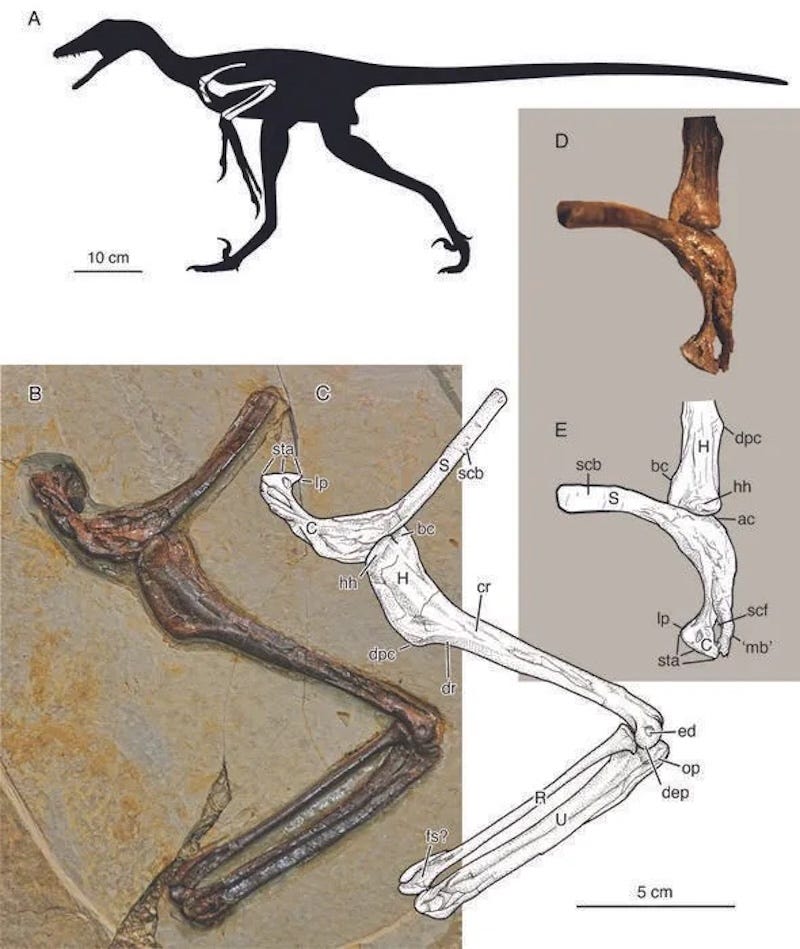
Fossilized forelimb bones of the newly described dinosaur Jian changmaensis. Credit: Zhou et al. (2026).
What set Jian apart
That is what makes Jian changmaensis stand out. The specimen consists of a fused shoulder blade, upper arm, radius, and ulna, and unlike the many flattened microraptor fossils recovered from the same region, it was preserved in three dimensions.
Jingmai O’Connor, associate curator of fossil reptiles at Chicago’s Field Museum and a co-author of the study, said Jian ranks among the largest microraptor specimens ever found. Based on an upper arm bone fragment roughly 10 centimeters long, she estimates the animal’s full wingspan was likely around 1.2 meters, putting it in the size range of a barn owl.
Microraptorines were not birds, but they were extremely close relatives of the dinosaur lineage that gave rise to them. Their bodies carried features, claws, sickle-shaped feet, and feathers, that seem to blur the line between dinosaur and bird. Steve Brusatte, a professor of paleontology and evolution at the University of Edinburgh in Scotland who was not involved in the study, called it wonderful, essentially a new fossil belonging to those dinosaurs standing right at the threshold of becoming true birds.
A bird hunter
The Changma Basin could have functioned as something like an open buffet for a tree-climbing predator like Jian changmaensis. The area was dominated by early birds, as the abundant pellet-like remains found there also suggest, remains that may represent the leftovers of the newly identified microraptor species’ dinners.
The researchers cannot prove that Jian itself produced those pellets. But Jian is the only non-avian body fossil found at Changma to date, and it was a carnivore considerably larger than the birds preserved at the site. Other microraptor fossils support the idea that these dinosaurs fed on a broad menu. Earlier specimens have been found with fish, lizard, mammal, and bird remains preserved in their guts, suggesting microraptorines were opportunistic hunters rather than narrow specialists.
For Jian changmaensis specifically, birds may have made especially easy targets. If the dinosaur lived at least partly in the trees and was capable of gliding, the researchers suggest, it may have ambushed early birds from the branches, or moved through the treetops the way a gliding sugar glider does today.
Lamanna acknowledged the limits of what the fossil can tell us. There is not much material to go on, he said, just a few bones from the shoulder and forelimb. That is enough to know that this intriguing new microraptorine lived 120 million years ago in what is now northwestern China, but not enough to learn everything we would want to know about these dinosaurs.
Source. Live Science (July 5, 2026). Zhou, L.Q., Lamanna, M.C., Poust, A.W., Li, D.Q., You, H.L., & O’Connor, J.K. (2026). “First Non-Avian Theropod (Dromaeosauridae, Microraptorinae) from the Bird-Bearing Lower Cretaceous Xiagou Formation of the Changma Basin, Gansu Province, Northwestern China.” Annals of Carnegie Museum, 92(2), 89 to 110.