

Archaeologists working at Gradište, near Mlado Nagoričane in North Macedonia, have completed another season on the site's Lower Terrace and found what increasingly looks like a sanctuary. The evidence includes a walled precinct, a small dining room furnished for ritual meals, a stone basin for purification, and a storage building whose great jars carry an image of a goddess pouring an offering.
The excavation was carried out under the annual programme of the National Institution Museum of Kumanovo, funded by North Macedonia’s Ministry of Culture and Tourism, and led by the archaeologist Dejan Gjorgjievski.
Ground already known to be strange
Earlier seasons on the Lower Terrace had exposed rock-cut structures dating to the fourth century BC alongside stone constructions resembling tumuli. Beneath those, the team found numerous votive vessels, small pits, and a perirrhanterion, the stone water basin placed at the entrance to Greek sanctuaries so that those entering could purify themselves. That object alone was a strong signal, since a perirrhanterion is not domestic equipment. It marks a threshold between ordinary space and sacred space.
This season’s work followed that lead.
A goddess stamped into a storage jar
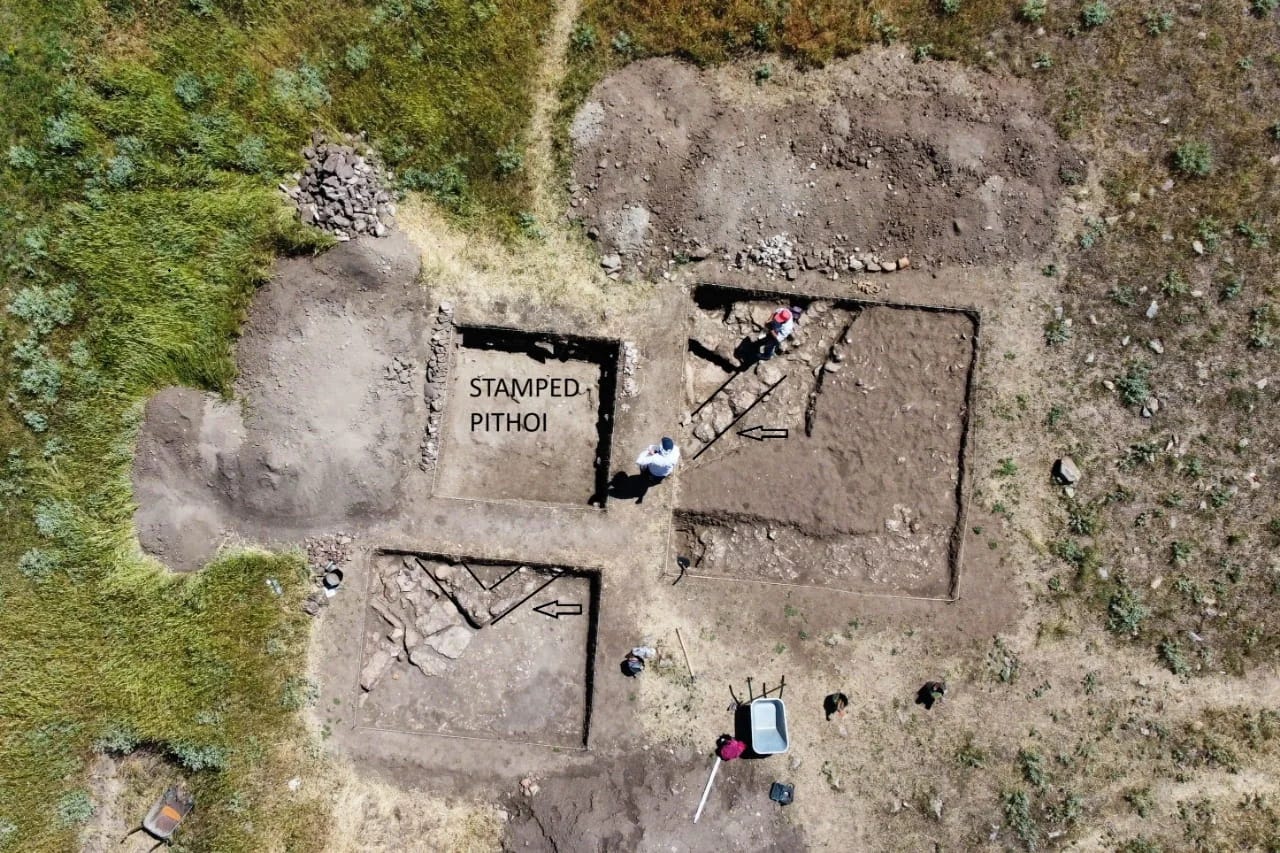
East of a previously identified tumulus, excavators uncovered the walls of a building filled with fragments of pithoi, the large ceramic jars used for bulk storage.
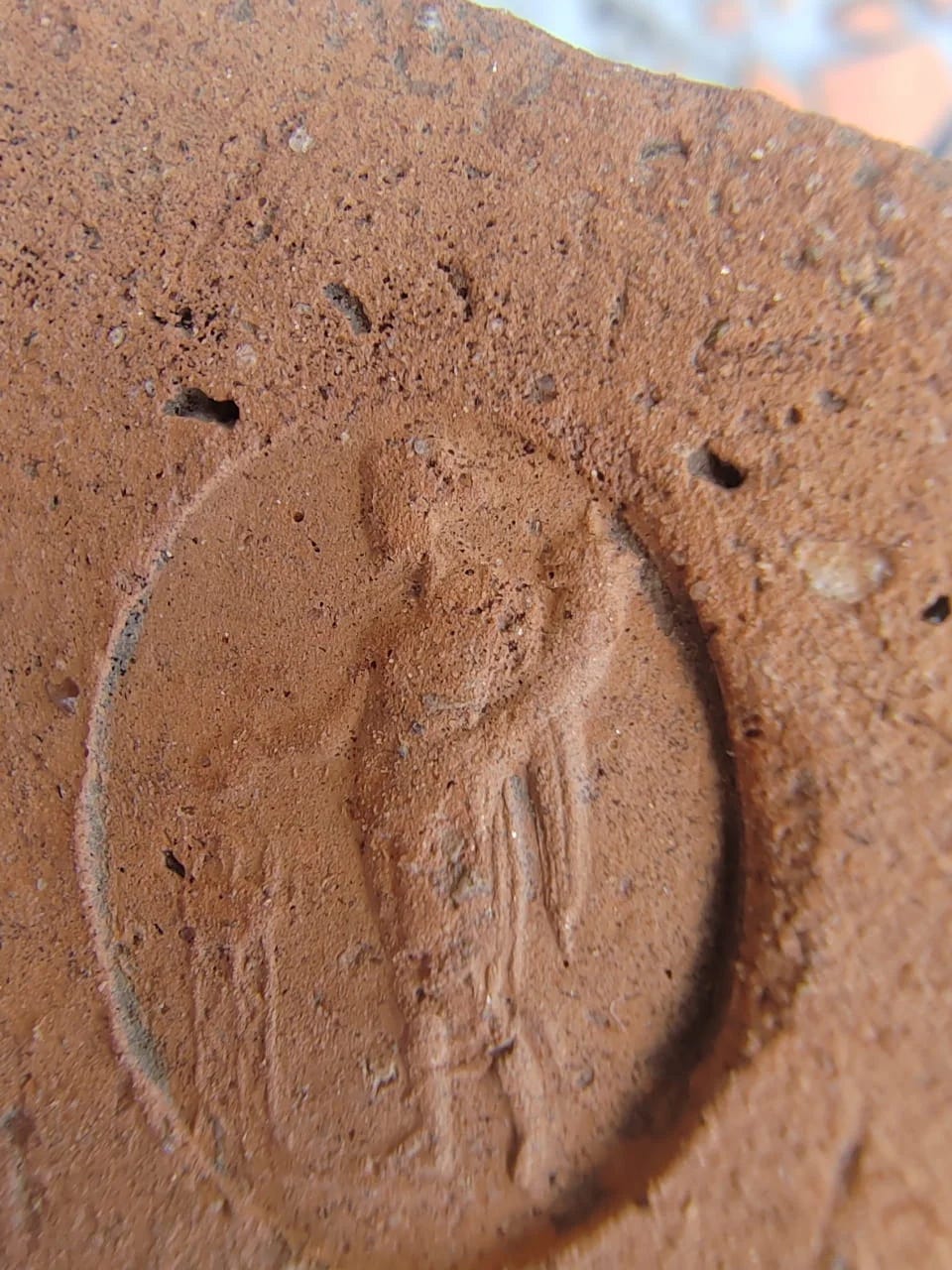
One pithos had its rim decorated with impressions made by a finger ring pressed repeatedly into the wet clay. The image shows a female deity, most probably Demeter, holding a cornucopia in one hand while pouring a libation from a kantharos over a tripod with the other. It is a complete sacrificial scene, reproduced over and over around the mouth of a storage vessel.
The dining room
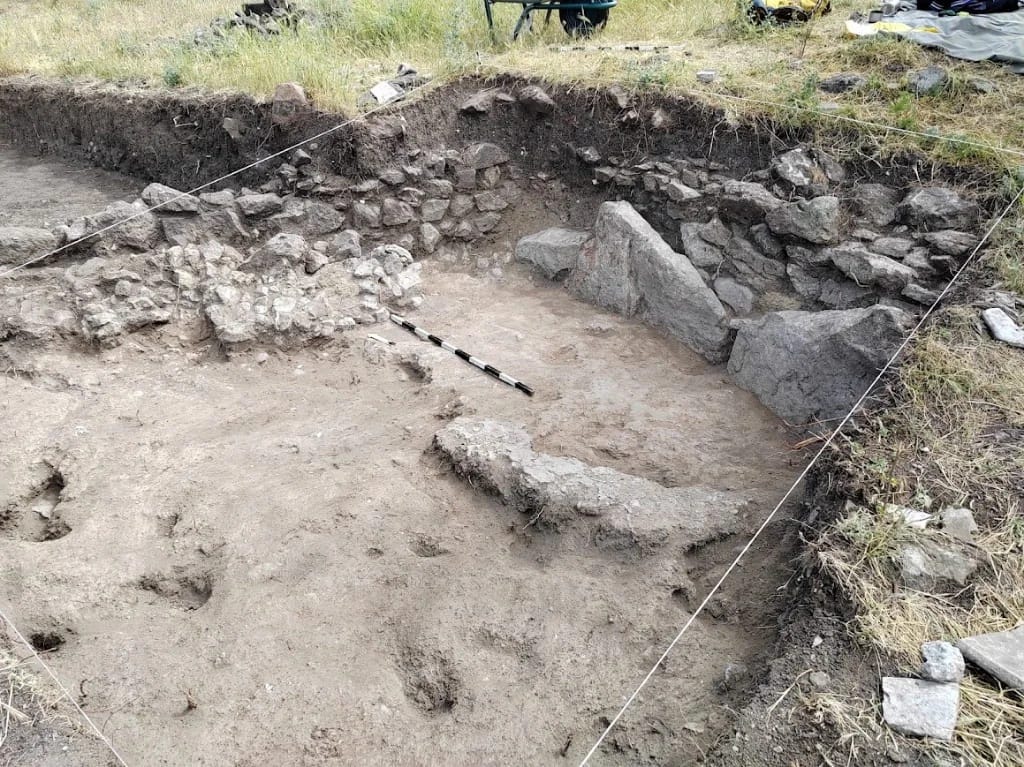
South of the storage building, the team found part of a wall that appears to have separated the ritual area from the wider settlement. Beside it stood a small room, and this is where the season’s most revealing material came from.
The floor held a large quantity of animal bone, including wild boar and goat, together with a substantial assemblage of Hellenistic tableware. Most of the pottery was not local. The inventory includes West Slope guttus vessels and West Slope kantharoi, small black-glazed echinus bowls stamped with palmette motifs, amphora fragments, hydriai, oil lamps, and pieces of terracotta figurines. That range points to real participation in long-distance trade networks rather than a provincial community making do with what it had.
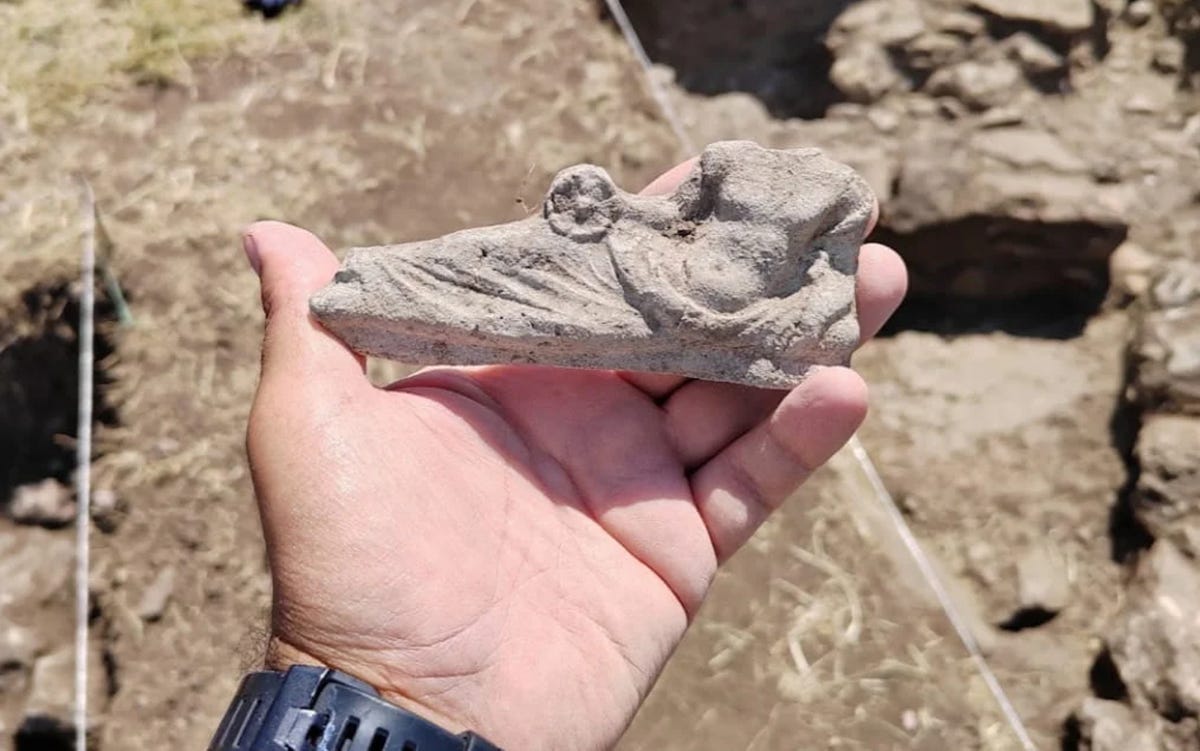
The room also produced a stone table base and fragments of an ornate dining couch. Among those fragments were a moulded foot and an appliqué showing a deity reclining on a kline, the ancient couch used for banqueting, holding a phiale, the shallow bowl used for pouring libations. Comparable decorative elements are known from the wealthy Hellenistic tombs at Pella and from the royal tombs at Aigai.
The room itself was modest in size despite the quality of what it contained. Two large triangular stones stood on its eastern side, and walls enclosed the space. The archaeologists interpret it as part of a temenos, the consecrated ground of a sanctuary, and most likely a setting for ceremonial dining. Their comparison is to the ritual dining rooms associated with the Sanctuary of Demeter and Persephone at Corinth, where small dining rooms lined the slopes and worshippers ate in the presence of the goddesses.
Wealth across the whole settlement
The ritual zone is not an isolated pocket of luxury. Earlier excavation on another part of the site examined a building with a peristyle courtyard, painted plaster walls, imported amphorae, and finely worked ceramics. Taken together, the material indicates strong connections to the cultural and economic networks of the Macedonian kingdom during the fourth and third centuries BC.
The open question
Future seasons will focus on examining the buildings found during this campaign in greater detail. The archaeologists also hope to establish whether a temple once stood in this part of Gradište.
That remains genuinely unresolved. What the season has produced is a consistent set of sanctuary components, a purification basin, a boundary wall, votive deposits, a dining room, and a deity stamped onto the storage jars. What it has not produced is the building those components would normally surround.
Source: Excavation by the National Institution Museum of Kumanovo, directed by Dejan Gjorgjievski, funded by the Ministry of Culture and Tourism of the Republic of North Macedonia. Images © Dejan Gjorgjievski, NI Museum of Kumanovo.