

Peering back toward the very edge of cosmic time, the European Space Agency's Euclid telescope has identified 31 quasars from the universe's infancy, among them two record-breaking objects whose light has traveled roughly 13 billion years to reach us.
The discovery, announced by ESA on July 6, 2026, more than doubles the number of known quasars from this period and gives astronomers their first genuine survey of the era, rather than just its rare, brightest outliers.
The findings appear in a study titled “Euclid, Discovery of 31 New Quasars at 6.6 Less Than z Less Than 7.8,” published in Astronomy and Astrophysics and led by Daming Yang, a PhD candidate at Leiden University in the Netherlands, together with J.F. Hennawi, F. Guarneri, J. Wolf, S. Belladitta, and a wider international team.
Monsters at the dawn of time
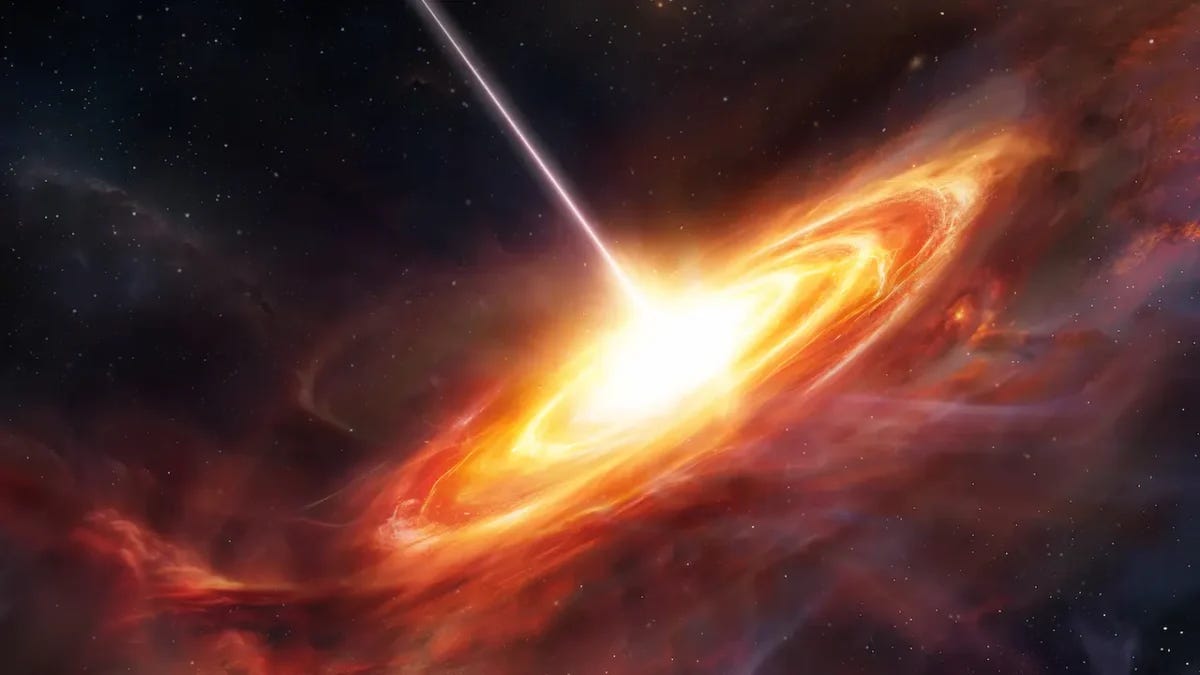
A quasar is what happens when enormous quantities of gas and dust spiral into a galaxy’s central supermassive black hole, heated by extreme gravitational and frictional forces to millions of degrees and releasing more light than every star in the galaxy combined, sometimes outshining its host by a factor of hundreds or even thousands. For decades, astronomers have hunted for the very earliest examples of this phenomenon, since they offer a direct window onto how the first supermassive black holes and galaxies actually formed.
Quasars from this deep in cosmic history are notoriously hard to find. Few galaxies had yet had time to grow large enough to produce one, and the light that did escape them is faint, stretched deep into the infrared by the universe’s expansion, and easily mistaken for an ordinary, much closer star.
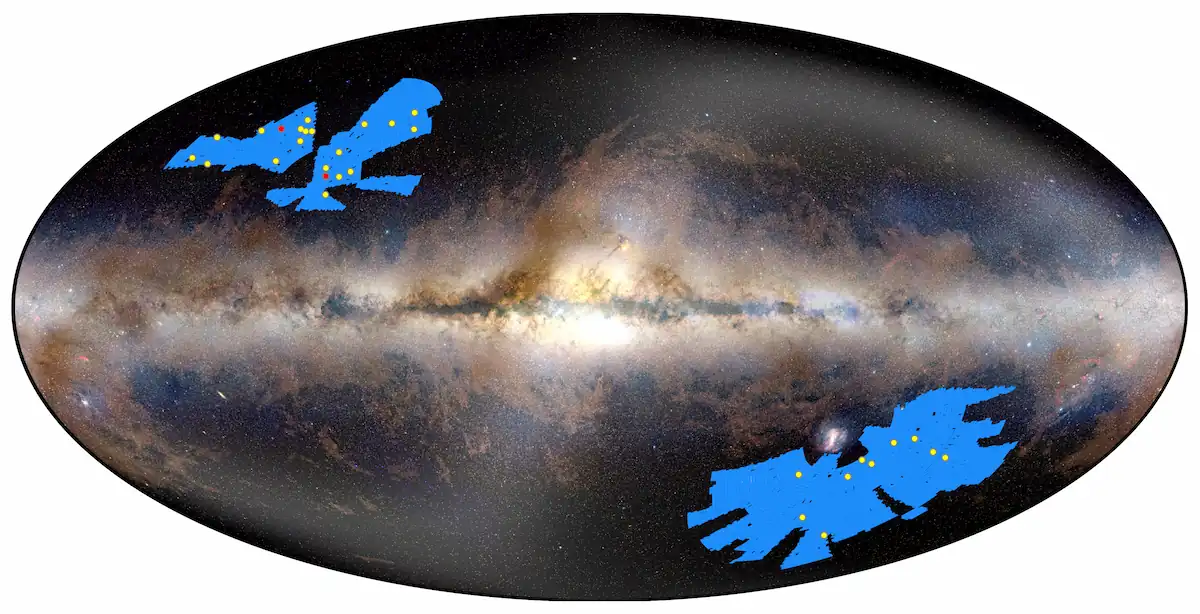
Locations of the 31 newly discovered quasars identified by Euclid. Credit: ESA/Euclid/Euclid Consortium/NASA/Planck Collaboration/A. Mellinger, Jean-Charles Cuillandre, and João Dinis.
Two new record holders
Of the 31 quasars Euclid identified, 12 date to the universe’s first 770 million years. Two go further still, and now stand as the oldest and most distant quasars ever documented, formed within the universe’s first 670 million years, just 5 percent of its current age of 13.8 billion years. The record holder, designated EUCL J172902.75+641018.1, has a redshift of 7.77. The runner-up, EUCL J125308.55+705432.3, comes in at a redshift of 7.69. Both beat the previous distance record, set in 2021 at a redshift of 7.64, by a comfortable margin.
Euclid’s advantage lies in its instruments. The telescope carries VIS, a visible-light imager capable of capturing sharp, high-resolution images across huge swaths of sky, paired with NISP, a near-infrared spectrometer and photometer built specifically to catch light stretched into infrared wavelengths by cosmic expansion. That combination lets Euclid cover enormous areas of sky while still picking out the faint, reddish smudges these ancient quasars actually appear as. Of the 31 new discoveries, 21 have already been confirmed through follow-up observations at the Keck Observatory.
A galaxy already building something huge
One of the two record-breaking quasars, EUCL J125308.55+705432.3, has already drawn closer scrutiny. Silvia Belladitta of the Max Planck Institute for Astronomy and her colleagues pointed the Northern Extended Millimetre Array, a powerful radio telescope on France’s Plateau de Bure, at the quasar’s host galaxy, tracing two distinct kinds of submillimeter light, one from star-forming gas clouds, the other from cold dust. Together, the signals revealed a galaxy producing new stars at a rate exceeding 250 solar masses a year, some 250 times the Milky Way’s own star-formation rate, while holding roughly 10 billion solar masses of material, about a tenth of our own galaxy’s total heft.
Belladitta described the find as a galaxy with all the ingredients needed to build a genuinely giant system, one already as massive as the hosts of the brightest known early quasars, sitting atop a huge reservoir of molecular gas ready to fuel intense star formation. The result raises an intriguing possibility, that ultraviolet-faint quasars like this one may occupy a different evolutionary phase than their brighter cousins, either growing their central black hole more slowly, or hiding much of that growth behind thick clouds of dust, a distinction Belladitta says future observations will need to untangle.
A survey, not just a record
What distinguishes this discovery from earlier ancient-quasar finds is its scale. Antonio La Marca, a PhD candidate at the Netherlands Institute for Space Research and an ESA research fellow on the Euclid team, said the result more than doubles the number of known quasars from this ancient period, and represents the first true census of quasars at the dawn of the universe, a meaningful step toward understanding these objects on a more fundamental level.
Yang made a similar point about what Euclid changes methodologically. Before this mission, he said, astronomers could only find a handful of the very brightest ancient quasars. Euclid searches far more efficiently across huge areas of sky, letting researchers capture much fainter light and turning the telescope into a genuinely unique tool for quasar hunting. It took astronomers more than a decade to find the first ten or so quasars from this deepest slice of cosmic time. Euclid gathered more than three times that number in about a year of searching.
A mystery that only gets sharper
The discovery deepens a puzzle that has increasingly troubled astronomers. Each of the 31 newly found quasars is powered by a black hole weighing roughly a billion times the mass of the sun, an enormous amount of material to have accumulated when the universe itself was not yet a billion years old. Study co-author Joseph Hennawi called them monsters that somehow already existed when the universe was in its infancy, adding plainly that researchers still lack a good understanding of how they grew so massive, so fast.
These quasars date to what astronomers call the epoch of reionization, the transformative period when the first stars and galaxies converted the young universe from a cold, dark, and largely neutral state into the hot, ionized cosmos we see structured around us today. As Yang put it, quasars can be used as lighthouses to study the gas that lies between us and them, letting researchers trace exactly how that reionization played out across cosmic history.
Valeria Pettorino, ESA’s Euclid project scientist, framed the discovery’s appeal simply. Ancient quasars are rare, she said, and interesting in their own right, but they also function as genuine time machines, letting researchers explore the early universe directly and understand how the very first generation of galaxies came to exist.
The James Webb Space Telescope has already turned its own instruments toward these newly identified quasars, and researchers are now working through that additional data. With Euclid still only partway through its planned six-year survey of one-third of the entire sky, astronomers expect the mission to turn up still more distant quasars in the years ahead, gradually assembling what Hennawi calls a genuine chronicle of the universe’s first billion years.
Sources. European Space Agency (July 6, 2026); NASA Science; Phys.org; CBS News; Astronomy Magazine; EarthSky. Yang, D., Hennawi, J.F., Guarneri, F., Wolf, J., Belladitta, S., et al. (2026). “Euclid, Discovery of 31 New Quasars at 6.6 Less Than z Less Than 7.8.” Astronomy and Astrophysics. doi.org/10.1051/0004-6361/202658883