

Beneath almost every forest floor in the northern hemisphere runs a vast, invisible partnership. Trees and certain fungi have evolved to live together, exchanging nutrients through threadlike networks that wrap around and between tree roots.
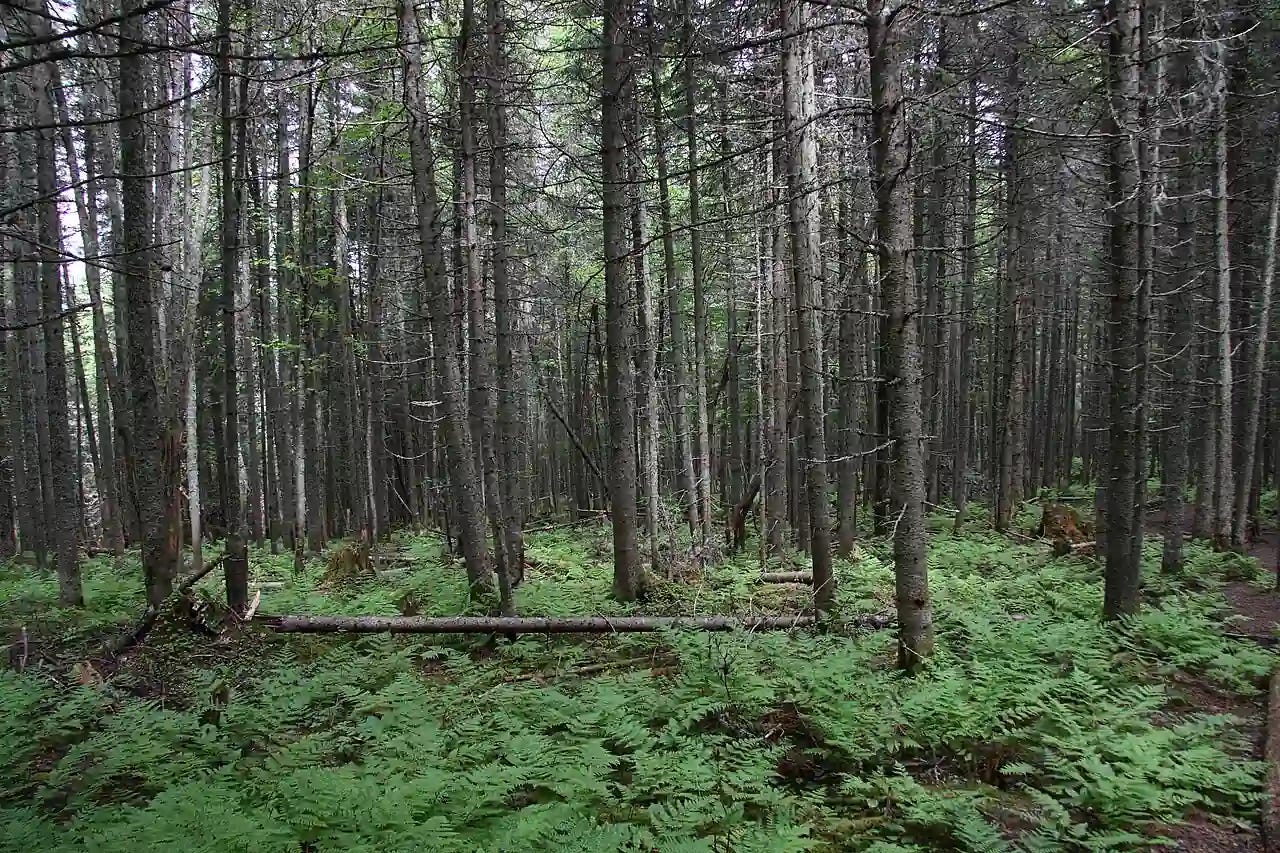
Weeds growing in a balsam fir (Abies balsamea) grove in Jacques Cartier National Park, Quebec. Photo credit: Cephas / Wikimedia Commons.
A new doctoral study from the Vrije Universiteit Brussel shows that when this partnership comes under the stress of metal pollution, the fungi involved don’t just struggle silently. They appear to communicate the danger through their own underground network, sending signals to parts of the fungus that never touched the contaminant at all.
The research is the doctoral thesis of Maarten Ottaway, supervised by Professor Joske Ruytinx at VUB, and was announced by the university on July 7, 2026.
An ancient partnership under new pressure
Most trees across the northern hemisphere depend on what are known as ectomycorrhizal fungi, organisms that form extensive networks around and between tree roots. In exchange for sugars from their host tree, these fungi help the tree draw up water and nutrients from the soil, an arrangement essential to forest health. That partnership, Ottaway’s research shows, is increasingly strained by human pollution, metal contamination among the most pervasive threats.
To study how the relationship holds up under that pressure, Ottaway focused on a single, well-studied pairing, the fungus Laccaria bicolor and poplar trees, and exposed the system to zinc and cadmium, two metals commonly found in contaminated soils. As Ottaway put it, metal pollution causes stress in both plants and fungi, and the goal of the work was to understand what actually happens to their partnership once metals like these enter the picture.
Two metals, two very different effects
The results were not what a simple model of toxicity would predict. Zinc suppressed the collaboration between tree and fungus, reducing growth on both sides of the partnership. Cadmium, despite being the more notoriously toxic of the two metals in most contexts, appeared instead to stimulate the interaction. Not all metals affect the symbiosis in the same way, Ottaway noted, and the underlying response turned out to be considerably more complex than the research team had initially expected.
A stress signal that travels
In the second strand of his research, Ottaway turned to the molecular mechanisms the fungus uses to sense stress and adjust its growth accordingly. He found that exposing the fungal network to cadmium sent a stress signal through the mycelium that reached even parts of the fungus with no direct contact with the metal at all. That finding points to something genuinely unexpected, an internal communication system operating within the fungus itself. As Ottaway explained, fungi appear capable of transmitting stress signals across far greater distances than researchers have previously been able to demonstrate.
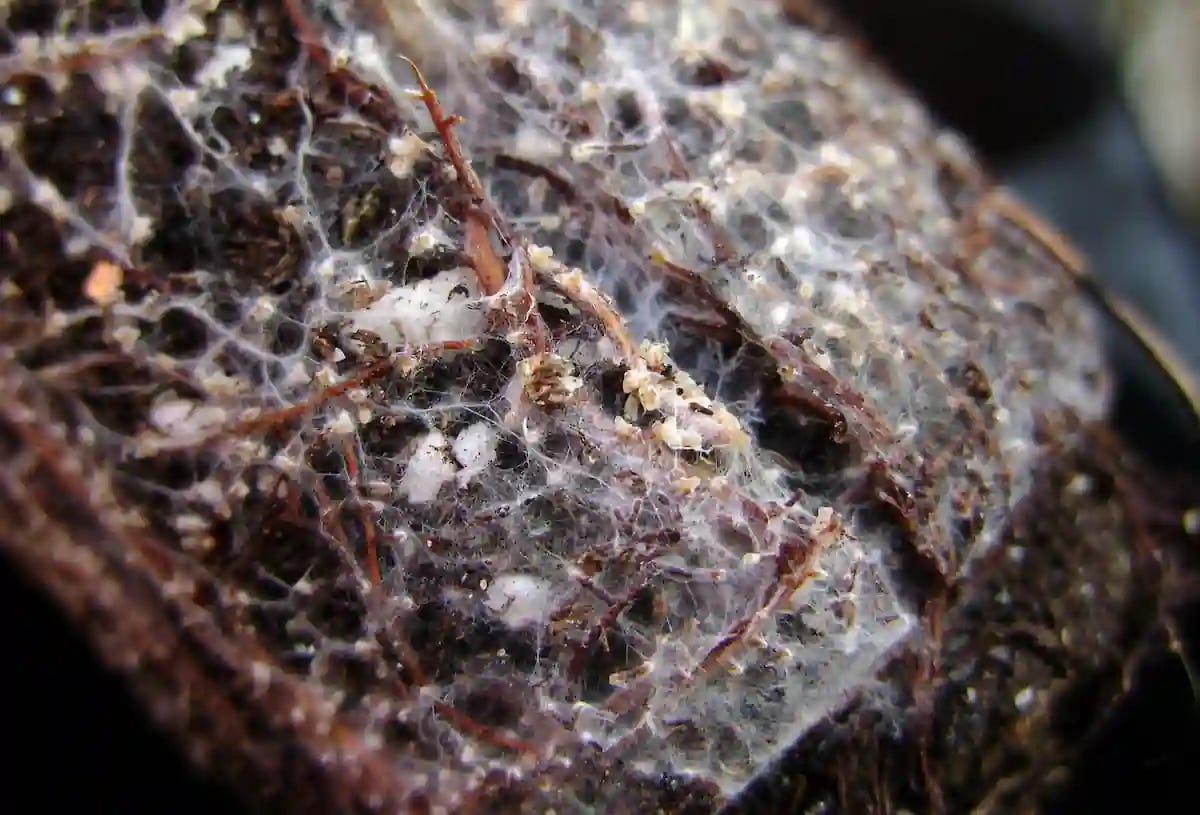
White mycelium of ectomycorrhizal fungi associated with the brown roots of white spruce (Picea glauca). Credit: André-Ph. D. Picard / Wikimedia Commons.
Alongside that discovery, Ottaway identified a specific protein believed to be involved in these stress responses, one that behaves differently from comparable proteins already described in yeasts and disease-causing fungi. The finding marks an early step toward untangling the distinctive biology of ectomycorrhizal fungi more broadly, a group whose molecular stress responses remain far less understood than those of their pathogenic relatives.
Why the underground matters above ground
For Ottaway, the value of the work extends well past the laboratory bench. Forests play a crucial role in biodiversity, climate regulation, and carbon storage, he said, and protecting these ecosystems depends on understanding how trees and fungi respond together to pollution and other stresses, not simply how each organism copes on its own.
The doctoral thesis, titled “Impact of Trace Metals on Ectomycorrhizal Symbiosis With an Emphasis on the Role of Cellular Redox Regulation,” builds on Ottaway’s earlier peer-reviewed work with Ruytinx’s group, published in Frontiers in Plant Science, which showed that the Laccaria bicolor and poplar symbiosis persists even under excess zinc, though at the cost of reduced growth in both partners. Taken together, the research paints a picture of a partnership that is neither simply broken nor simply resilient under pollution, but one that responds to different threats in distinct, and only partly understood, ways.
Source. Vrije Universiteit Brussel (July 7, 2026). Maarten Ottaway, “Impact of Trace Metals on Ectomycorrhizal Symbiosis With an Emphasis on the Role of Cellular Redox Regulation,” doctoral thesis, VUB.