

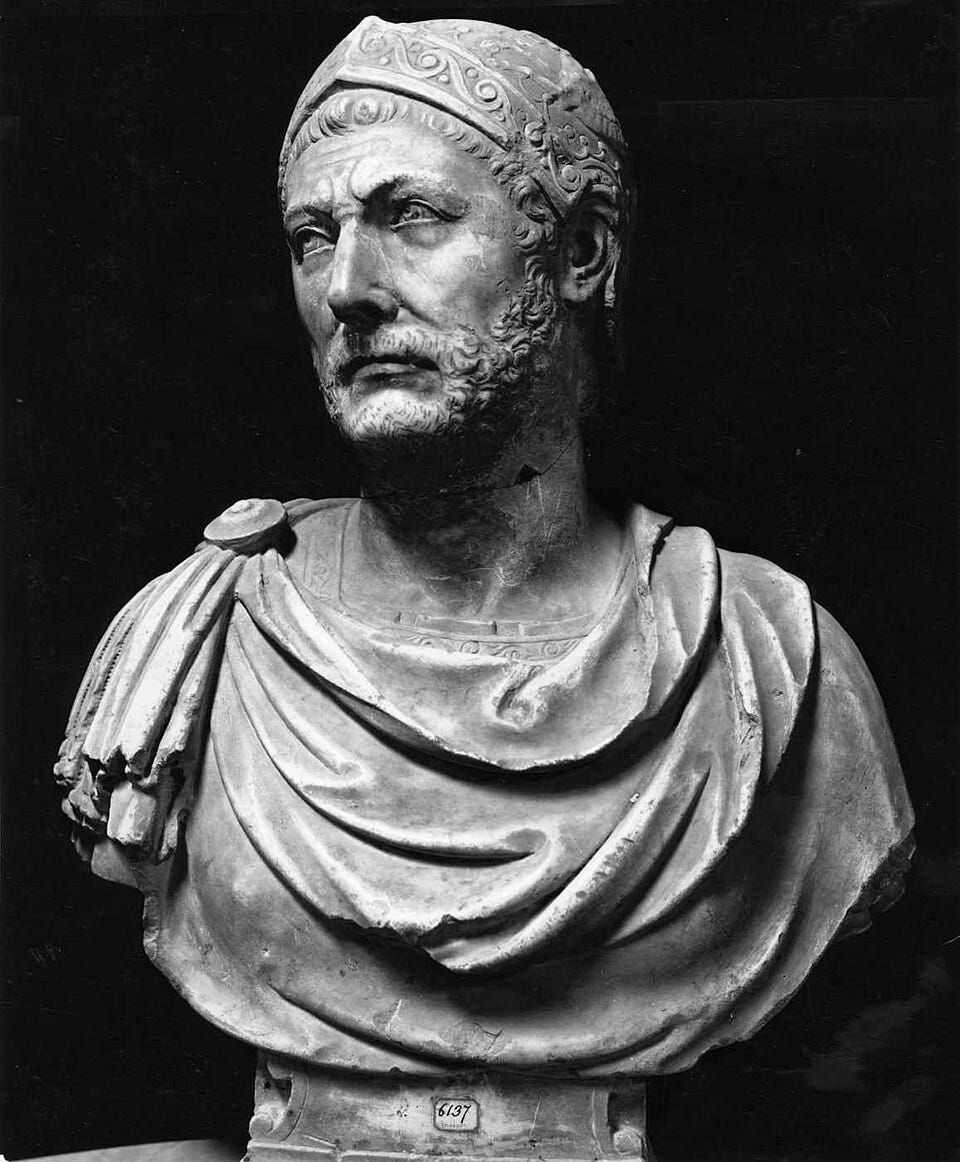
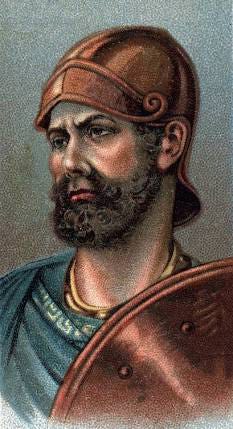
Widely regarded as one of the greatest military strategists in human history, Hannibal Barca (247–183 BC) was the Carthaginian general who nearly brought the Roman Republic to its knees during the Second Punic War.
He is best known for his audacity, his psychological warfare, and an impossible logistical feat that shocked the ancient world.
The Audacious Trek: Crossing the Alps
In 218 BC, determined to strike Rome directly, Hannibal did the unthinkable. Instead of attacking by sea, he marched an army of roughly 40,000 infantry, 9,000 cavalry, and 37 war elephants from Iberia (modern-day Spain), across the Pyrenees, through hostile Gaulish territory, and straight over the treacherous, freezing peaks of the Alps.
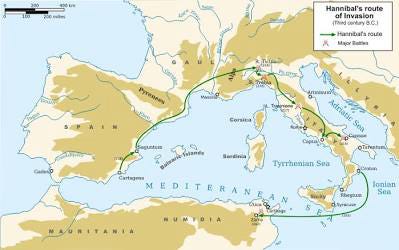
The crossing was brutal. Hannibal lost nearly half his forces to the elements, steep drops, and tribal ambushes. Yet, when his battered army descended into northern Italy, the sheer shock value caught Rome completely off guard.
Masterclass Battles
Once in Italy, Hannibal spent 15 years devastating Roman armies on their own soil without losing a single major engagement. His tactics are still taught in military academies today:
Battle of the Trebia (218 BC) He used psychological baiting, triggering the hot-headed Roman commander to cross a freezing river into a hidden Carthaginian ambush.
Battle of Lake Trasimene (217 BC) Hannibal orchestrated the largest tactical ambush in military history, trapping a Roman army of 25,000 between the lake's shore and the misty hills.
Battle of Cannae (216 BC) His absolute masterpiece. Outnumbered nearly 2-to-1, Hannibal used a "double envelopment" tactic. He allowed his center line to deliberately weaken and retreat, drawing the overconfident Romans forward. His strong flanks then swung around, completely surrounding and wiping out nearly 70,000 Roman soldiers in a single day.
"You know how to win a victory, Hannibal, but you do not know how to use it."
Maharbal, Hannibal's cavalry commander, after Hannibal chose not to march directly on the heavily fortified walls of Rome after Cannae.
The Downfall
Despite destroying entire generations of Roman legions, Hannibal lacked the siege engines and reinforcements from Carthage to force a final surrender. Rome adopted a strategy of attrition evading direct battle with Hannibal while striking Carthaginian territories elsewhere.
Eventually, the Roman general Scipio Africanus studied Hannibal's own tactics and took the war to Carthage's doorstep in North Africa. Hannibal was recalled home, where he was finally defeated at the Battle of Zama in 202 BC. He spent his final years in exile, constantly pursued by Rome, before taking his own life via poison to avoid capture.
The most famous quote attributed to Hannibal Barca is:
"Aut inveniam viam aut faciam."
I will either find a way, or I will make one.
The Context
According to historical tradition, Hannibal said this to his generals during his invasion of Italy in 218 BC.
His commanders had just informed him that it was completely impossible to cross the Alps with an entire army let alone an army accompanied by 37 war elephants. The terrain was too rugged, the weather too brutal, and the mountain passes too narrow.
Hannibal’s response became the ultimate ancient declaration of pure determination and tactical defiance.
Another Famous Exchange
While the "find a way" quote is his most legendary, Roman historians also recorded a famous, witty exchange later in his life between Hannibal and his great rival, Scipio Africanus. Years after the war ended, the two generals met at the court of Ephesus, where Hannibal was living in exile.
Scipio asked Hannibal who he thought the greatest military commanders in history were:
1. Hannibal named Alexander the Great first, for conquering vast empires with small forces.
2. He named Pyrrhus of Epirus second, for his mastery of logistics and camp layout.
3. He named himself third.
Scipio laughed and asked, "What would you have said if you had defeated me at Zama?"
Hannibal replied: "In that case, Scipio, I should have placed myself before Alexander, before Pyrrhus, and all other generals."