

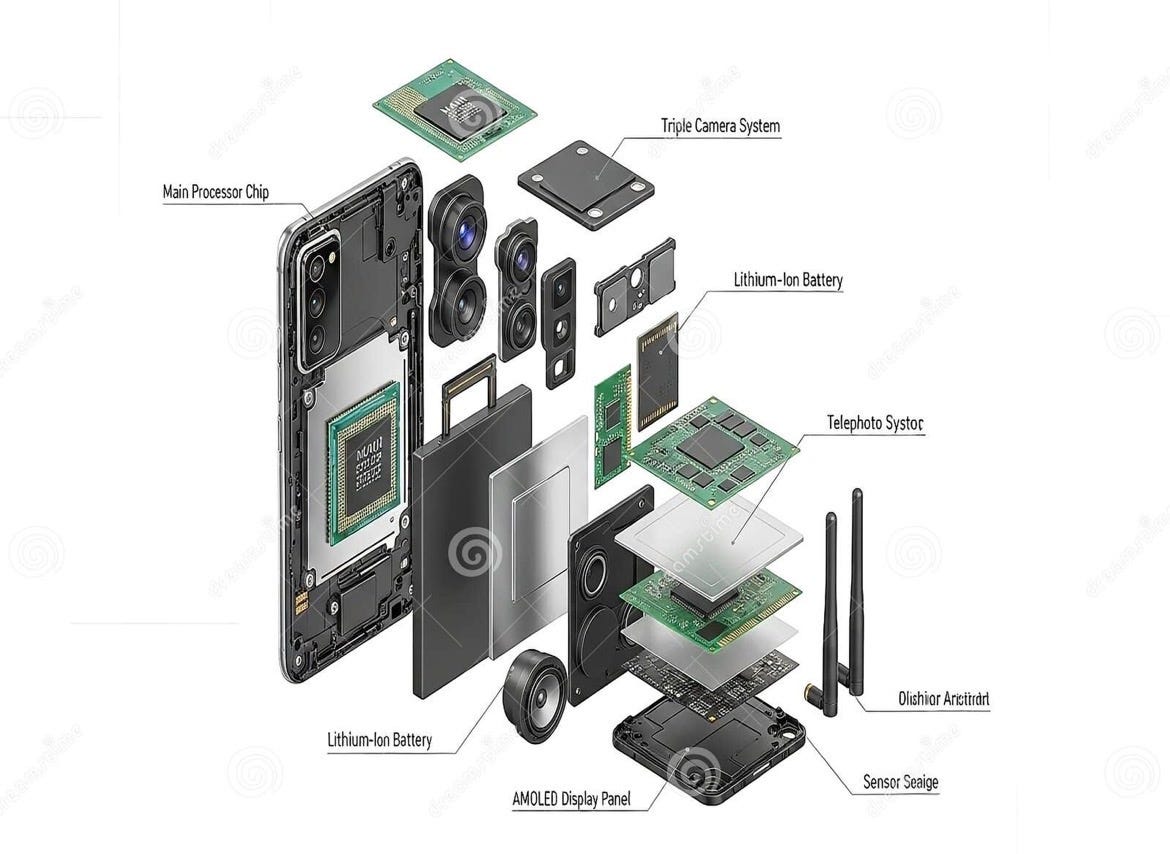
At its core, a smartphone is a tiny, highly advanced computer, a two-way radio, and a digital camera packed into a sandwich of glass and aluminium.
The Brain (The SoC): Inside is a System on a Chip (SoC). Unlike an old desktop PC where the processor, graphics card, and memory are separate, a phone crams the CPU, GPU, and cellular modems onto a single tiny silicon wafer. It processes billions of calculations per second using electrical impulses (1s and 0s).
The Screen (OLED/LCD): Your screen is made of millions of microscopic red, green, and blue lights (pixels). When you look at an image, the phone's brain tells specific pixels to light up at varying intensities to create colors.
The Touch: Beneath the glass is a grid of ultra-thin, transparent wires carrying an electrical charge. When your finger (which also conducts electricity) touches the screen, it alters the electrical field at that exact coordinate. The phone calculates where the disruption happened and triggers the corresponding action.
The Connection: When you load a video, your phone translates data into radio waves. It broadcasts these waves to the nearest cell tower, which sends the request through massive underground fiber-optic cables to a server across the world, fetches the data, and beams it right back to your antenna.