

Across the mountain villages of eastern Crete, small Byzantine churches carry murals whose reds have survived war, weather, and centuries of candle smoke. Until now, no one had scientifically examined what those reds were actually made of.
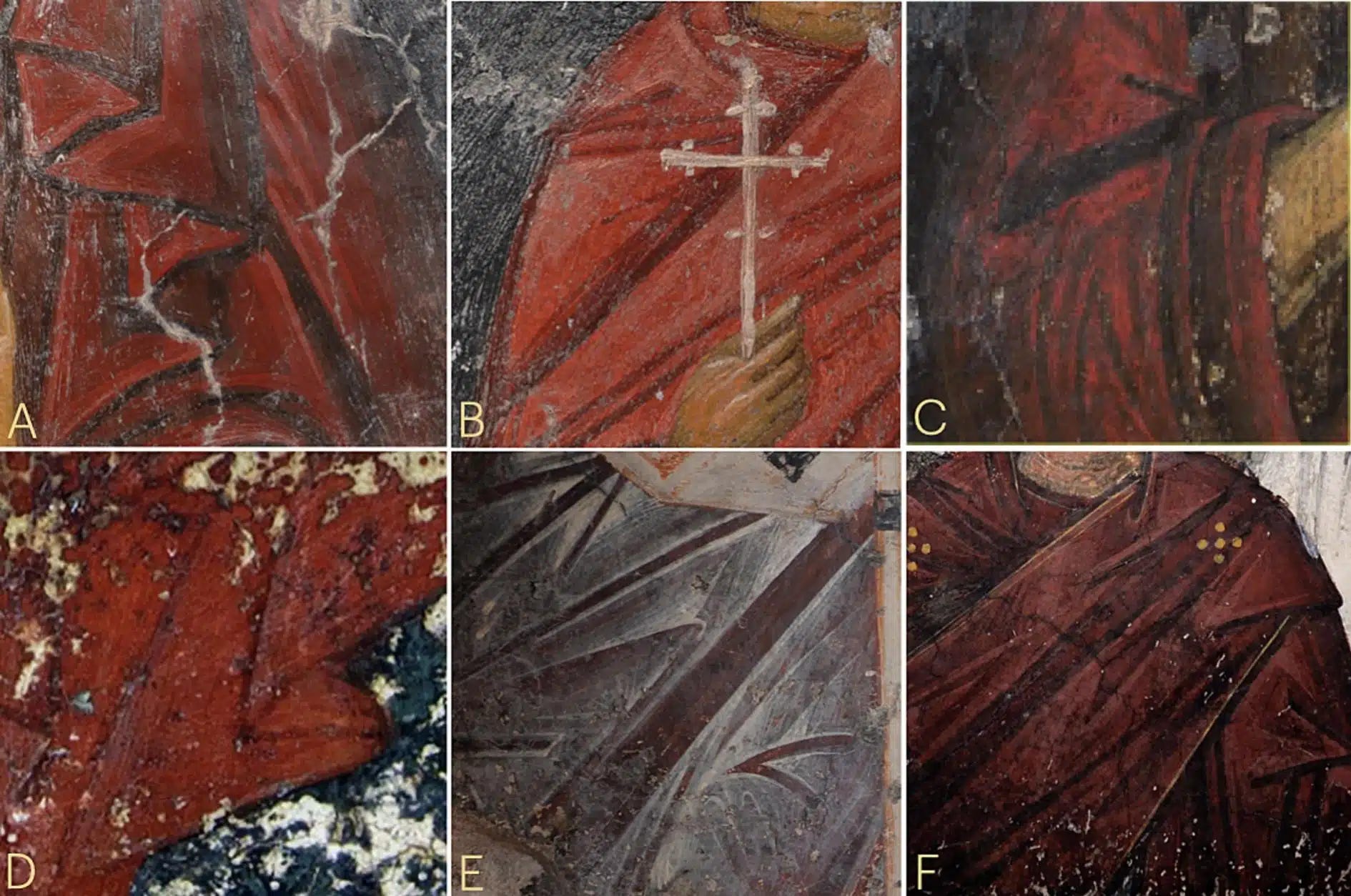
A new study has finally analyzed the pigments behind the murals of Lassithi, and the results reveal a sophisticated, evolving craft tradition that painters carried across the region for eight hundred years.
The research, published in the Journal of Archaeological Science, Reports, was led by Yiğit Zafer Helvacı together with Roberto Giustetto, Giacomo Chiari, Tiziana Cavaleri, Maurizio Aceto, Klio Zervaki of the Ephorate of Lassithi Antiquities at the Archaeological Museum of Agios Nikolaos, and Monica Gulmini. The project grew out of Helvacı’s doctoral research, a collaboration between the University of Turin, the Centro Conservazione e Restauro Venaria Reale, and Greece’s Ministry of Culture, funded through the European Union’s Marie Skłodowska-Curie program.
A region overlooked until now
Crete holds a central place in Byzantine art, yet its eastern region, Lassithi, had remained largely absent from the archaeometric record, a gap the researchers set out to close. The team examined murals from eleven churches across the area, spanning a remarkable stretch of time, from the eighth century through the sixteenth.
To identify what the painters actually used, the researchers took tiny paint samples from the church walls and analyzed them using portable X-ray fluorescence, microscopy, and X-ray diffraction, a combination capable of identifying pigments down to their mineral composition without requiring large or destructive samples.
Three reds, one shared palette
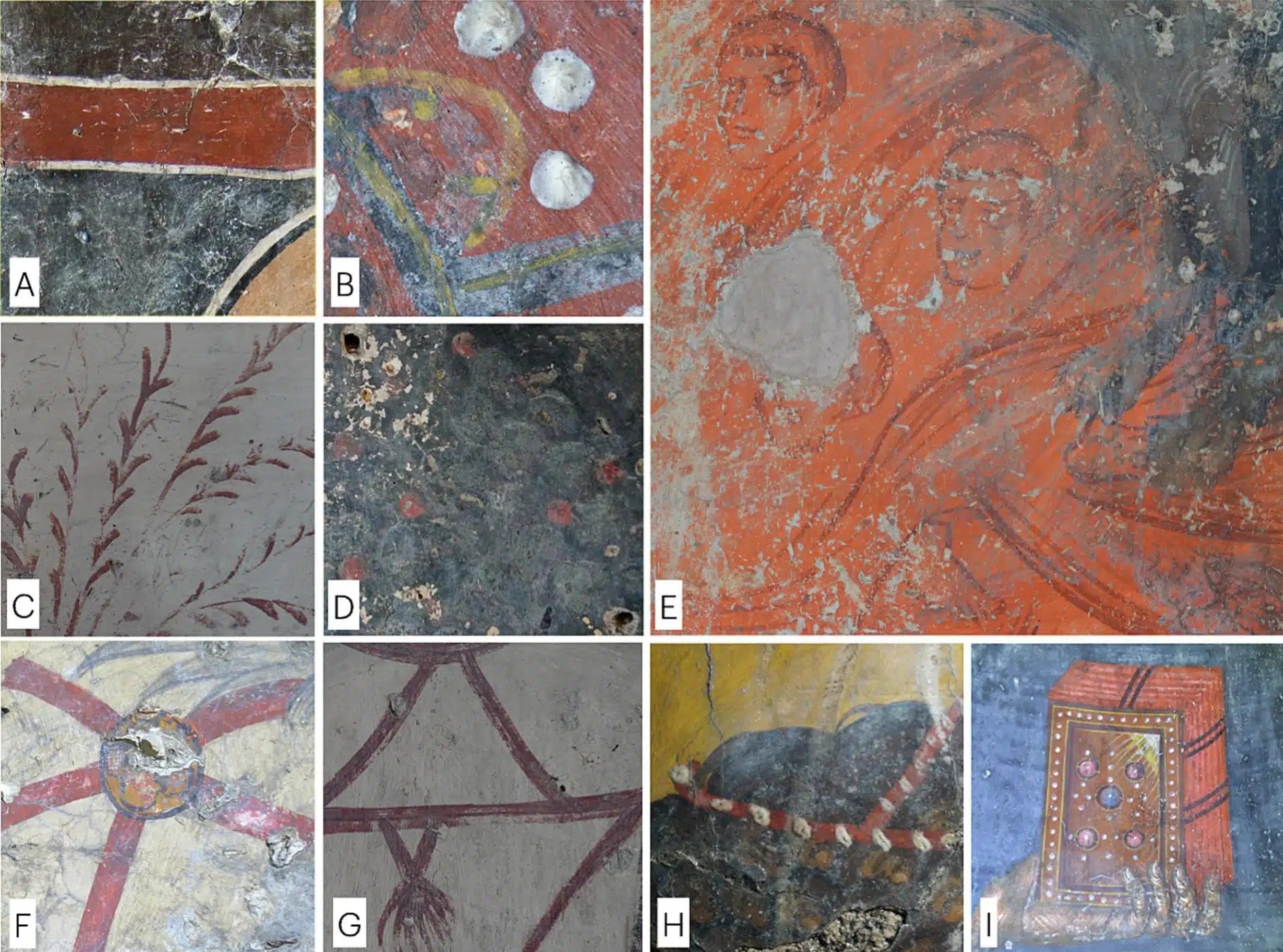
Red ochre, a natural iron-based pigment, turned out to be the most common color across nearly every church studied, appearing in a range of different shades and grain sizes depending on its source and preparation. Vermilion, a considerably more expensive pigment made from mercury sulfide, showed up far more often than the researchers had expected, used not only to render important figures but also for borders and background layers, a more generous use of an costly material than earlier assumptions about provincial Byzantine painting had suggested.
A third pigment, red lead, appeared mainly in combination with the other two, mixed with vermilion or ochre rather than applied on its own. Painters bound these pigments with lime, and many worked using the secco technique, applying paint to plaster that had already dried rather than to a wet surface. Combined with the ochre and vermilion, this approach let artists build up the traditional Byzantine three-tone shading style, layering light, medium, and dark reds to model faces, clothing, and other fine detail.
Centuries have left their own marks
The study also documented how time itself had altered the murals. In several churches, the sustained heat of candles burning near the walls had transformed yellow pigment into red in small, isolated patches, a slow chemical change wrought by centuries of flame exposure. Humidity did its own damage elsewhere, darkening areas painted with vermilion and red lead into dull gray or black patches, a reminder that these murals have been chemically active objects for far longer than they have been passive works of art.
A shared tradition across the centuries
Taken together, the findings point to painters across Lassithi drawing on a genuinely shared set of materials and techniques over hundreds of years, even as both pigment quality and the use of vermilion specifically appear to have improved after the fourteenth century. Researchers say the resulting dataset can now guide future conservation work on murals that, in many cases, already show real signs of aging from heat and humidity exposure.
With this study, Lassithi joins a still-short but growing list of Cretan regions to receive this kind of material analysis, helping to close a longstanding gap in the archaeometric understanding of Byzantine art in the island’s less-studied eastern churches.
Source. Helvacı, Y.Z., Giustetto, R., Chiari, G., Cavaleri, T., Aceto, M., Zervaki, K., and Gulmini, M. (2026). “Characterisation of Pigments and Technical Features of Byzantine Mural Paintings From Eastern Crete (Lassithi). A Diachronic View of Reds Between the 8th and 16th Centuries.” Journal of Archaeological Science, Reports. doi.org/10.1016/j.jasrep.2026 (S2352409X2600221X)