


Few questions expose the fault lines between myth, scripture, and science as sharply as this one: how long have humans been here? Across cultures, the earliest answers were rarely neutral “estimates.” They were moral histories, political legitimations, and cosmological maps. Only very late did humans develop instruments and methods capable of turning the question into a measurable problem.
What follows is a source driven account of how major chronological traditions framed human antiquity, why their numbers diverge so radically, and what modern dating can state with high confidence.
1) The First Durable Chronologies: Kingship Before the Flood
The oldest surviving attempts at deep human time appear not as “human evolution” but as political theology: the idea that civilization begins when kingship descends from the divine realm, and that the earliest rulers belong to an era qualitatively unlike the present.
A canonical example is the Sumerian King List tradition. In one influential recension preserved in later copies, eight kings’ rule in five cities for a combined 241,200 years, after which a flood sweeps over the land.
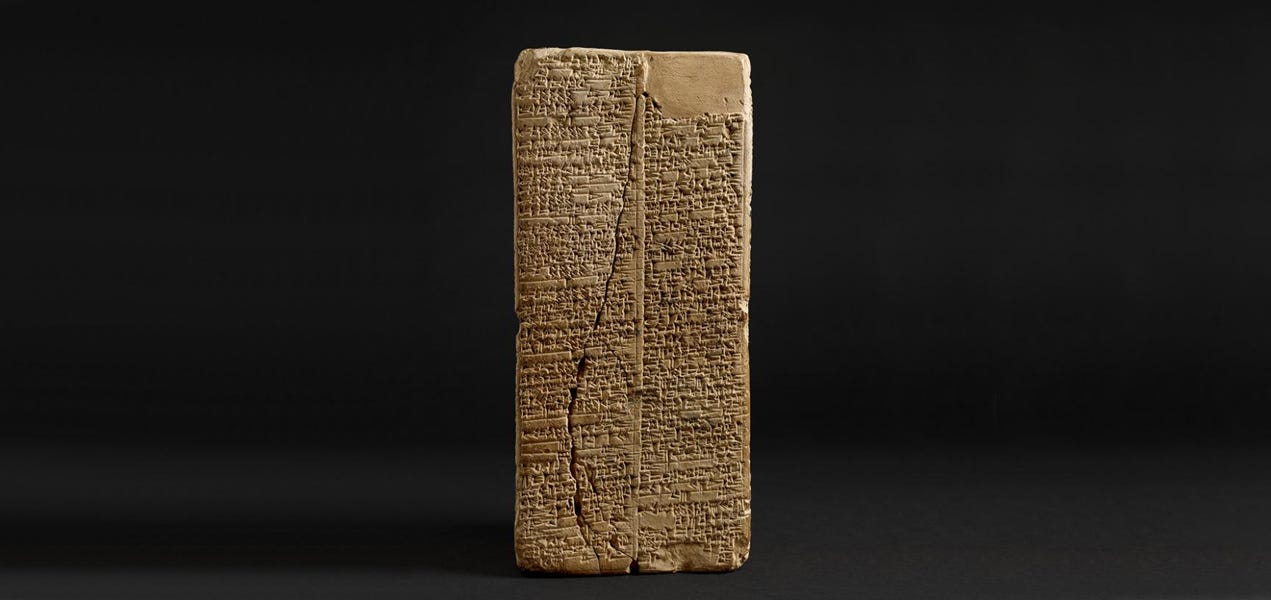
This is not a historical claim in the modern sense. It is a statement about the structure of time: before the flood, reigns are superhuman in scale; after the flood, kingship continues, but the world becomes more legible and more human.
A closely related move appears in the Hellenistic era through Berossus, a Babylonian priest writing in Greek. In a fragment preserved via later chronographic quotation, he records ten antediluvian kings whose reigns total 120 saroi, equated to 432,000 years, ending with a great flood.
These figures are best read as symbolic magnitude and dynastic legitimacy rather than literal regnal history. Their purpose is to place a culture’s institutions on the far side of ordinary time.
2) Scriptural Time and the Birth of “Creation Dates”
When chronologies become anchored to scriptural genealogies, the numbers compress dramatically. The core method is not astronomical or geological measurement but arithmetic over lineage and reign lengths, producing a world measured in millennia rather than hundreds of millennia.
Two prominent examples illustrate how “creation dates” function as theological calendars rather than empirical reconstructions:
The Hebrew calendar (Anno Mundi) places the creation epoch in 3761 BCE, in a tradition that treats this as the beginning of the world era used for dating.
The Byzantine era (Anno Mundi), used historically in parts of Eastern Christianity, reckons the creation era to 5509 BCE (with the year beginning on September 1 in that system).
In the Latin Christian world, the most famous early modern calculation is James Ussher’s chronology, which deduced a creation date of 23 October 4004 BCE (proleptic Julian).
A correction is important here: when these creation epochs are translated into “how long humans have existed,” they do not yield tens of thousands of years. Ussher’s creation date corresponds to roughly six thousand years before the present, not anything like 67,000. The much larger figure only appears if one confuses “cosmic cycles” or symbolic time scales with genealogical chronography, or if one blends unrelated chronological systems.
3) Why Text Alone Could Not Solve the Problem
Even the most sophisticated premodern chronographers were constrained by the same hard limit: writing is recent relative to human existence. The earliest writing systems emerge in late fourth millennium BCE Mesopotamia, with the earliest administrative texts associated with Uruk and closely related contexts.
Anything earlier depends on oral tradition, mythic narrative, or retrospective compilation. Those sources can preserve memories of real disasters and social transformations, but they cannot reliably yield absolute dates for the origins of humanity. The result is predictable: chronologies become reflections of cultural priorities, not neutral measurements.
4) What Science Can Date, and Why “The First Human” Is a Moving Target
Modern science reframes the question by separating three very different problems:
How old is the universe?
How old is the Earth?
How old are anatomically modern humans, and how do we define them?
For the first two, modern measurement is unusually tight. In the standard cosmological model constrained by cosmic microwave background and related datasets, the age of the universe is approximately 13.787 billion years (model dependent but precisely estimated within that framework).
For Earth, radiometric dating and solar system chronology converge on about 4.54 billion years.
The third problem is harder not because the methods are weak, but because the category is fuzzy. Evolution does not produce a single moment when one species becomes another. It produces gradients, branching populations, and transitional mosaics.
Still, for Homo sapiens, the evidence base is strong enough for firm statements. Fossils and associated dating from Jebel Irhoud (Morocco) have been published with an age on the order of 315,000 years, pushing the origin of our species deep into the Middle Pleistocene.
So, the most defensible modern answer is this:
If by humans you mean anatomically modern Homo sapiens, the best current evidence places our species at hundreds of thousands of years old, not thousands.
If by humans you mean a broader category such as the genus Homo or “humanlike ancestors,” the timescale extends further back, but the exact boundary becomes increasingly definitional rather than purely factual.