

Chinese goldsmiths of the Ming Dynasty were masters capable of producing jewelry so fine it could pass for delicate woven thread, and the proof lies scattered through royal and noble tombs across Hubei province.
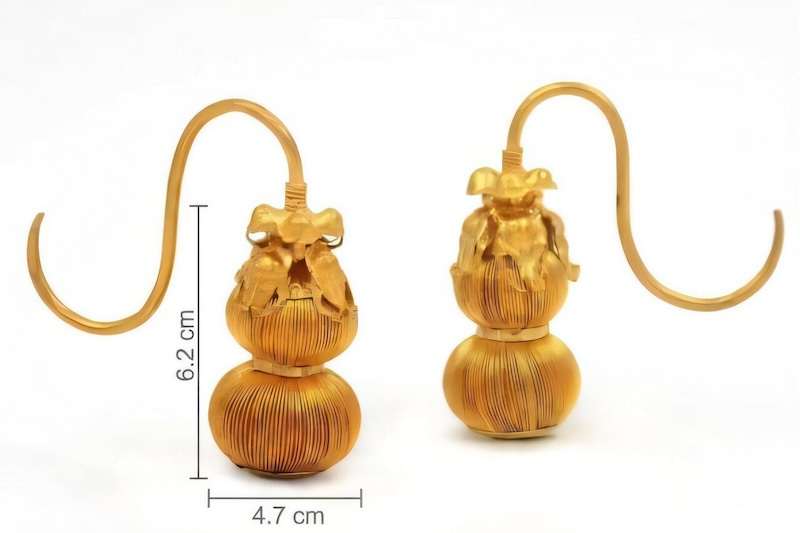
Experimentally reproduced Jin zhe si gourd-shaped earrings. Credit: Tian, Z., Ren, K., & Jiang, Z. (2026).
A newly published study has cracked one of the true secrets of their craft, a lost goldworking method that mimics the lacy look of filigree without a single strand of wire.
The research, carried out by Tian Zhihao, Ren Kai, and Jiang Zhenyu of the Gemmological Institute at the China University of Geosciences in Wuhan, appears in the journal npj Heritage Science. The technique at its center, known as Jin zhe si, is mentioned in historical records, but this is the first time researchers have reverse engineered the actual production process to see precisely how Ming goldsmiths achieved it.
Filigree’s clever impostor
Traditional filigree is made by twisting and soldering fine metal threads into intricate, lace-like patterns, an elegant and labor-intensive form of metalwork found across many cultures. Jin zhe si produces a visually similar effect through an entirely different route. Rather than wire, it relies on ultra-thin sheets of gold folded and corrugated into a fine, satin-like texture, a method so effective at imitating woven thread that written records had, for centuries, obscured how it was actually made. As the researchers put it in their paper, the technique investigated in this study contains no true wire at all, in contrast to genuine filigree, which always involves applying a real straight or twisted metal thread.
That confusion runs even deeper than modern misunderstanding. The name Jin zhe si roughly translates as “gold folded wire,” a label that seems to have misled later readers for generations. A sixteenth-century inventory known as the Tianshui Bingshan Lu lists thousands of jewelry pieces, including dozens described as woven with gold thread, phrasing the study authors connect directly to this folded technique rather than to any actual threadwork.
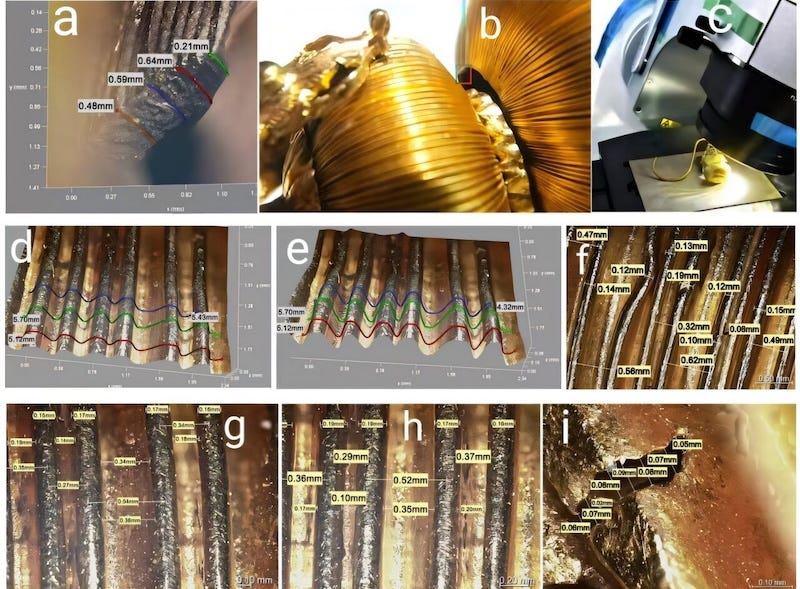
Microscopic observations of bends and fractures in a Jin zhe si gold earring from the Ming Dynasty. Credit: Tian, Z., Ren, K., & Jiang, Z. (2026).
A prince’s earrings under the microscope
The team’s evidence came from a pair of gold earrings recovered from the tomb of Prince Zhu Zairong, a Ming Dynasty prince who died in 1545. His tomb, in Hubei province, belongs to a wider group of princely burials that have produced some of the richest known examples of Ming gold jewelry. Each earring takes the form of a double gourd-shaped pendant made of thin gold, topped with four gold leaves and vines hanging from a small gold hook.
Examining the pieces under a stereomicroscope, the researchers produced new technical drawings documenting their structure in detail. What they found settled the question. The surface carried a fine, regular corrugated texture created by very thin sheets of gold folded into layers. There was no wirework of the kind filigree requires, and no internal filling material of any sort, meaning the jewelry’s entire delicate appearance came from folding the gold foil itself.
Rebuilding a lost process
Armed with that understanding and with the historical textual record, the team applied reverse engineering to reconstruct every stage of production. They cut high-purity gold foil about 0.15 millimeters thick, roughly twice the thickness of a human hair, softened it through annealing, pressed it into fine grooves, and folded it back on itself to build up the corrugated, hyperbolic surface. The result was a replica gourd earring that matched the original in shape, surface texture, and weight, differing by only about one gram.
Why only gold would do
To understand why Ming goldsmiths settled on gold specifically, the researchers repeated the process using silver and aluminum foil under identical conditions. Both alternative metals either tore or failed to hold their shape. High-purity gold, by contrast, could be folded repeatedly into extremely fine corrugated forms without cracking or splitting. As the team concludes, only gold could be folded over and over without breaking, retaining its corrugated structure throughout the molding process, a property tied directly to gold’s exceptional ductility.
The study estimates that once the technique was mastered, an experienced goldsmith could complete one earring in roughly a day. The authors are careful to stress the larger point, however. Despite producing a similar visual effect to filigree, Jin zhe si is not a variant or a shortcut version of it, but a distinct and self-contained technique in its own right, one that bridges the gap between a centuries-old written description and the physical evidence finally recovered from the material itself.
Source. Tian, Z., Ren, K. & Jiang, Z. (2026). “Restoration of Ming dynasty Jin zhe si. A lost Chinese goldsmithing technique.” npj Heritage Science. doi.org/10.1038/s40494-026-02757-4
Fascinating.
I subscribed because this is much more than a story about jewellery—it is a story about recovering human ingenuity. I love the idea that centuries later, careful observation and experimentation can resurrect a craft that written records alone could not fully explain.
What struck me most is that the beauty of these pieces came not from extravagant materials, but from extraordinary skill. It reminds us that civilizations are remembered not only for what they built, but for how they thought.
Thank you for making archaeology, history, and craftsmanship come alive through such engaging storytelling. I'm looking forward to reading more of your work.