

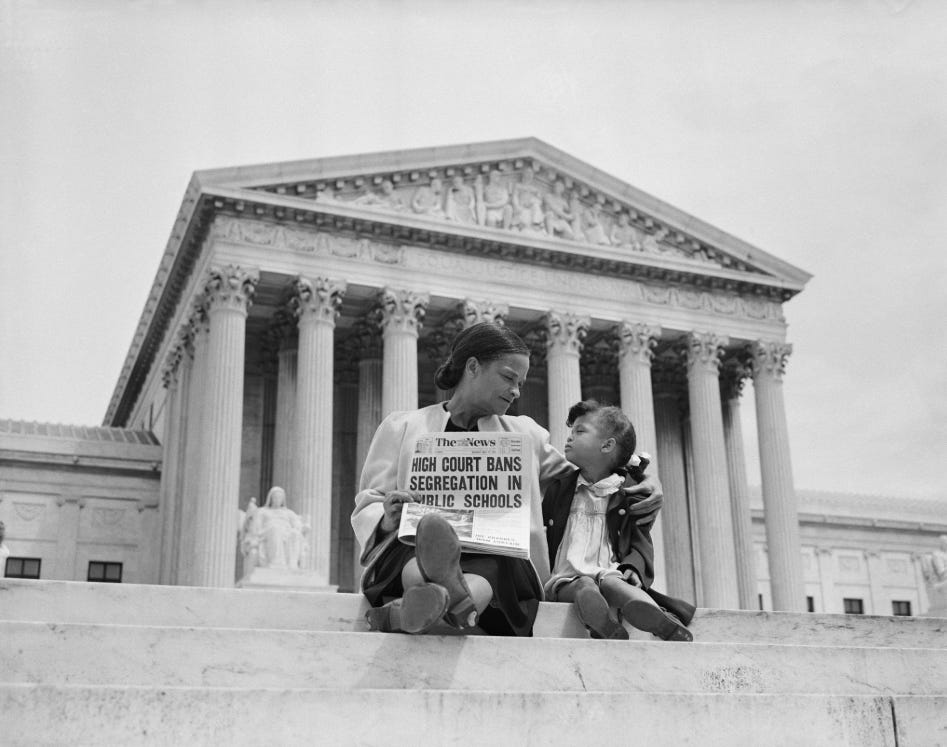
The Decision outlines the historic U.S. Supreme Court ruling on May 17, 1954, which funda
mentally overturned the “separate but equal” doctrine in public education.
Here are the key takeaways from the Court’s ruling:
The Impact of Segregation: Chief Justice Earl Warren delivered the unanimous opinion, arguing that school segregation could not be judged purely by “tangible” factors like buildings or curricula. Instead, the Court had to look at the psychological effect of segregation itself on children.
Intangible Inequalities: Drawing on contemporary psychological research, the Court agreed that legally separating African American children solely based on race generated a profound feeling of inferiority. This systematically undermined their motivation to learn and deprived them of equal educational opportunities.
The Historic Verdict: The Court famously concluded that “in the field of public education, the doctrine of ‘separate but equal’ has no place. Separate educational facilities are inherently unequal.” They ruled that this segregation violated the Equal Protection Clause of the Fourteenth Amendment.
The “All Deliberate Speed” Loophole: In a follow-up 1955 ruling known as Brown II, the Court ordered local school authorities to integrate public schools “with all deliberate speed.” Because it failed to set strict, specific legal deadlines, this vague wording inadvertently allowed for decades of delay, pushback, and intense conflict across Southern states.
Sources: https://www.britannica.com/event/Civil-Rights-Act-United-States-1964
image: Celebrating the Brown v. Board ruling. Source: Bettmann / Bettmann Archive