

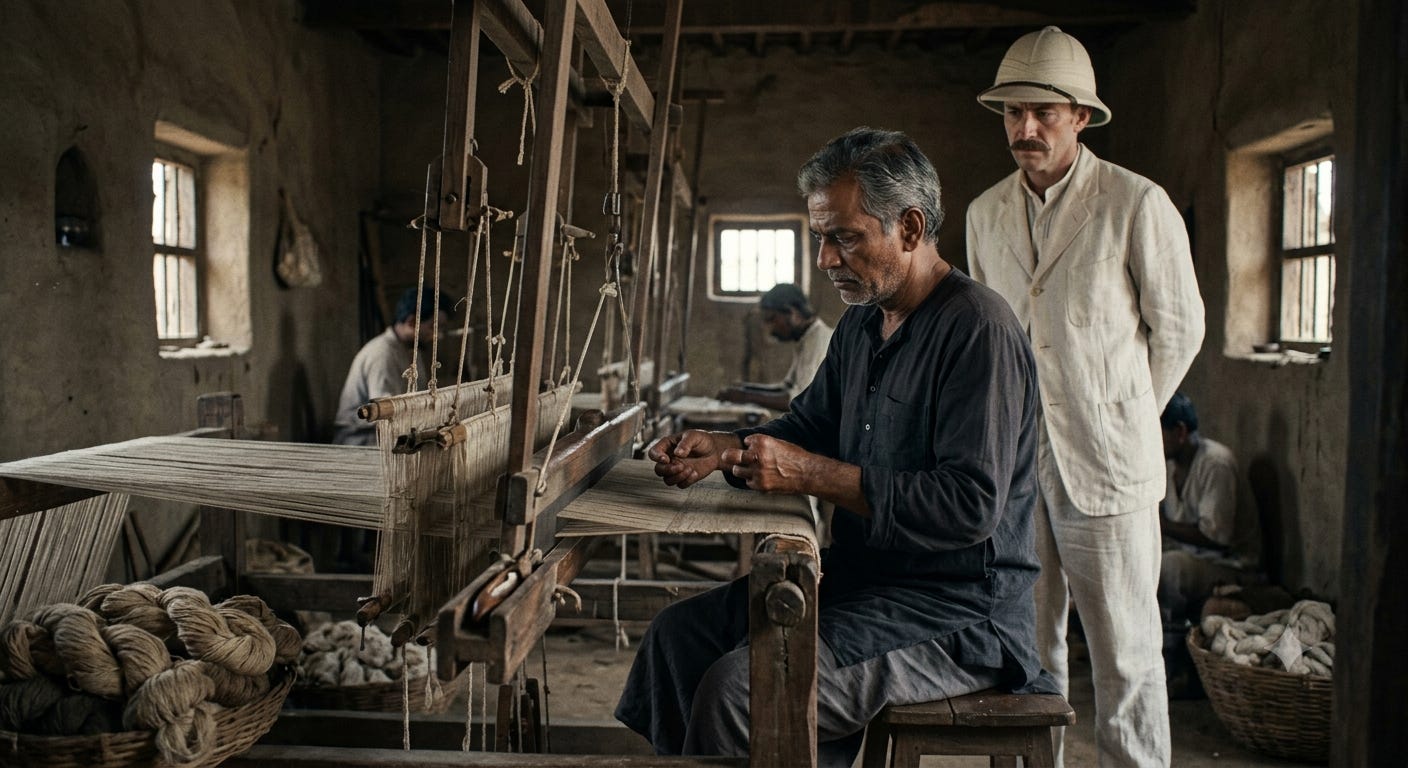
The destruction of the Indian textile industry under British colonial rule is one of the most tragic and documented cases of deliberate economic deindustrialization in history.
This story is referencing about British officials physically cutting off the thumbs or fingers of Indian artisans is a deeply rooted piece of history, though its context is slightly different than a literal, widespread state policy of mutilation.
The Origin of the “Severed Thumbs”
The historical account of severed thumbs originates from a 1772 book titled Considerations on India Affairs, written by William Bolts, a merchant who witnessed the East India Company’s (EIC) brutal operations in Bengal.
Bolts documented that the EIC forced local silk weavers into absolute debt bondage. The company paid weavers far below market prices, legally barred them from selling to anyone else, and physically flogged them if they resisted. Bolts recorded that the terror and slavery-like conditions became so unbearable that some weavers chopped off their own thumbs so they could no longer be forced to spin silk for the company.
“The weavers, desirous of obtaining their freedom... have been known to cut off their own thumbs to prevent their being forced to wind silk.”
— William Bolts, 1772
Over time, this horrific reality evolved into the widespread oral history that British soldiers directly amputated the thumbs of weavers to destroy competition. Whether it was self-mutilation out of desperation or direct violence by EIC agents, the historical consensus is clear: the British systematically “amputated” the livelihood of Indian artisans.
How the Industry Was Systematically Destroyed
The British did not just target individuals; they dismantled the entire economic system of Indian manufacturing to favor the mills of Manchester. They did this through a three-pronged strategy:
1. Crushing Tariffs and Fake “Free Trade”
While British cotton was flooded into India entirely duty-free, the British government slapped massive import tariffs (up to 70–80%) on Indian textiles entering Britain. This artificial pricing completely priced Indian weavers out of the European market.
2. Forcing India into Resource Extraction
Before British intervention, India exported finished goods (vibrant chintz, ultra-fine Dacca muslin, calico). The British flipped this entirely. They forced India to export its raw, raw cotton to Britain’s mechanized factories, and then forced Indian consumers to buy back the cheaply made, machine-manufactured British cloth.
3. Destruction of the Looms
EIC agents and sepoys (local soldiers) routinely smashed traditional wooden handlooms and arrested master weavers who tried to work independently.
By 1834, the devastation was so absolute that the British Governor-General of India, William Bentinck, wrote in an official letter:
“The misery hardly finds a parallel in the history of commerce. The bones of the cotton-weavers are bleaching the plains of India.”
The “Broken Machines” Irony
Regarding the artisans being forced to work on “broken machines”: the historical irony is that the British Industrial Revolution was heavily subsidized by the wealth drained from India, yet the colonial government actively prevented India from modernizing its own infrastructure.
When mechanization did come to India via British-owned mills later in the 19th century, Indian laborers worked under brutal, unregulated conditions with zero labor rights, effectively forced into low-wage factory servitude to handle the very raw materials their ancestors used to turn into the world’s finest luxury fabrics.
Book by William Bolts