

Before the first dinosaur ever walked the earth, before plants or animals had even begun colonizing dry land, the ocean floor belonged to strange stalked animals called crinoids, distant relatives of starfish that looked like sea flowers swaying in the current.
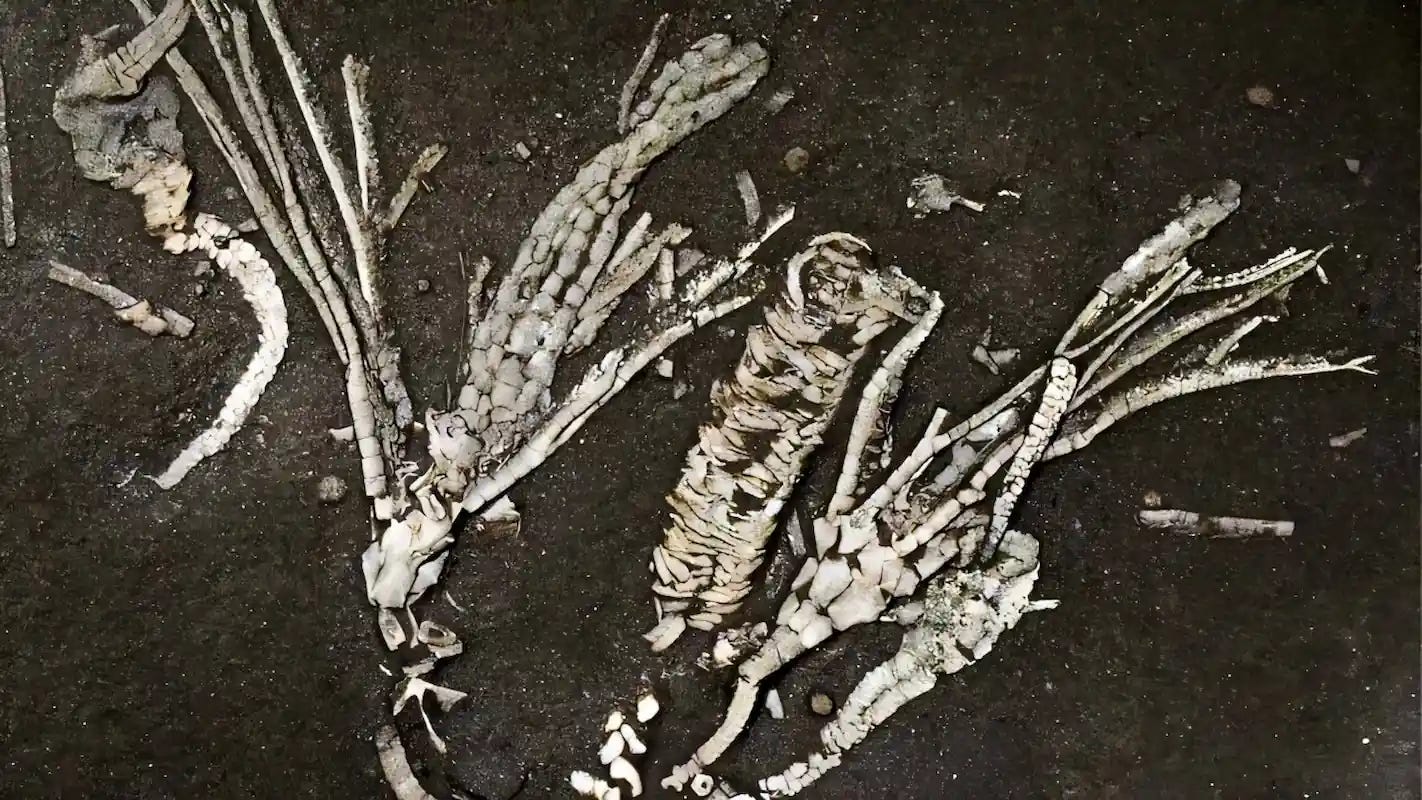
Crinoid Soft Tissue Fossil. Credit: University of Oklahoma
Paleontologists at the University of Oklahoma have now made an extraordinarily rare find, fossilized soft tissue from one of these ancient creatures, preserved in astonishing detail more than 450 million years after the animal died.
The discovery, announced on July 2, 2026, centers on Dendrocrinus simcoensis, and specifically on its tube feet, the small, delicate structures crinoids use to feed and interact with their environment. The find represents only the second known example of preserved soft tissue in any crinoid fossil, and by a wide margin the oldest.
Why soft tissue almost never survives
Fossilization is, by its nature, selective. As Lena Cole, assistant curator of invertebrate paleontology at the Sam Noble Oklahoma Museum of Natural History and lead author of the study, explained, soft tissues like skin, eyes, or internal organs are the first parts of an animal to decay after death, which is why most fossils preserve only hard parts such as bones, teeth, or shells. Soft tissue survives only when the surrounding environment behaves almost like a natural refrigerator or vacuum sealer, conditions that are exceedingly rare in the geological record.
Given how many crinoid fossils exist, Cole put the odds in stark terms. Crinoid fossils number in the millions, she noted, and this is only the second time soft tissue has ever turned up among them, a preservation event she called truly one in a million.
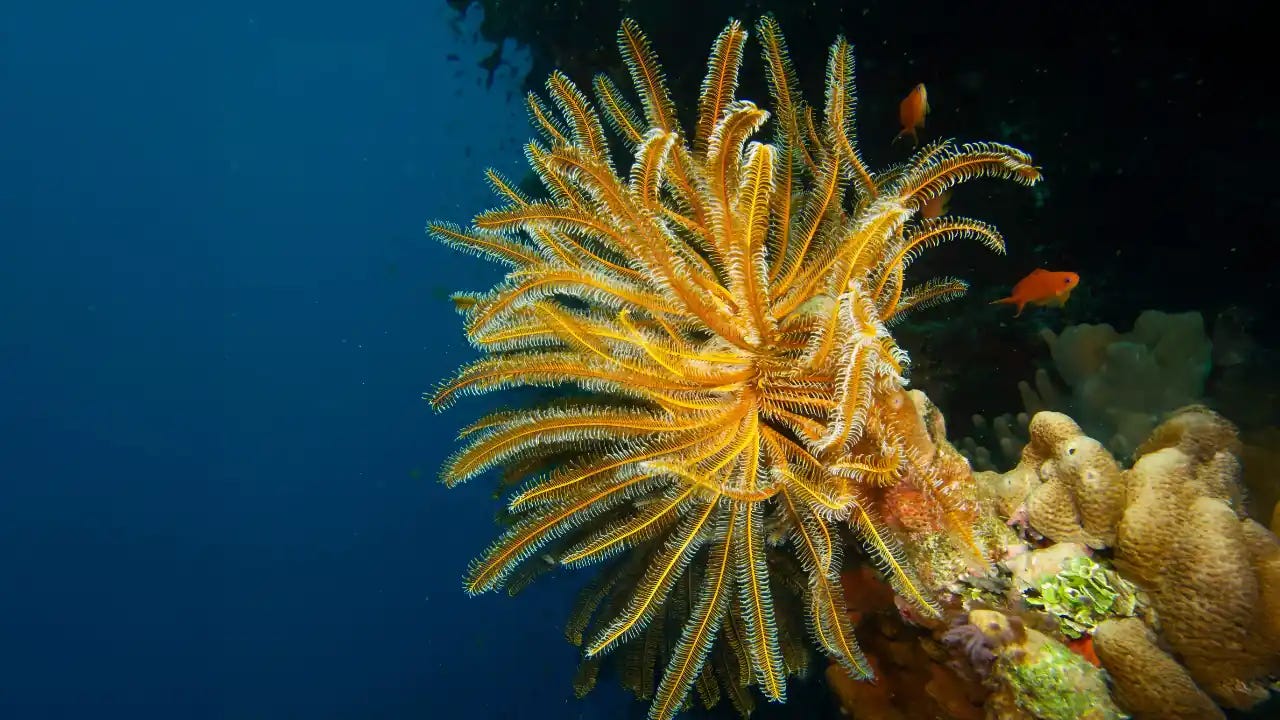
Modern Crinoid – Feather Star. Credit: Jackdrafahl / pixabay.com
Older than the oldest dinosaur
Cole’s co-author, David Wright, also an assistant curator of invertebrate paleontology at the Sam Noble Museum, emphasized the sheer span of time the tissue has survived. These soft tissues, he noted, are more than 200 million years older than the oldest known dinosaur, a gap that places the fossil deep in the early Paleozoic, before complex life had even ventured onto land.
Tube feet are not incidental anatomy. They govern how a crinoid feeds, how it interacts with ocean currents, and what ecological niche it can occupy, and their size, spacing, and structure vary with habitat and feeding strategy much the way a mammal’s tooth shape reflects its diet. Wright drew that comparison directly, noting that differences in tube foot structure reveal what kind of environment a species lived in and how it captured food. Cole added that comparison with living crinoids shows the ancient species’ anatomy was markedly different from its modern relatives, offering fresh insight into how crinoid feeding strategies have shifted across hundreds of millions of years.
A window onto the earliest reefs
Beyond what it reveals about crinoids specifically, the researchers see the fossil’s greater value in what it says about the ecology of early Paleozoic oceans, an era when crinoids were among the many animal groups flourishing in some of Earth’s very first reef environments. Wright noted that fossilized remains of long-extinct species can display features well outside the range seen in any living relative, and that comparing the ecological roles of extinct and modern species helps researchers understand how patterns of adaptive evolution have shifted over time and what forces shaped the modern biosphere. Because so few soft tissues survive in early echinoderms generally, each new discovery like this one substantially expands what scientists can infer about ancient ecosystems, feeding strategies, and evolutionary pathways.
Found in a museum, not the field
Major paleontological discoveries are often imagined as happening outdoors, on active dig sites. This one did not. The fossil had sat preserved for years in the collections of Montreal’s Musée de paléontologie et de l’évolution, a small institution sustained entirely by community donations, until Cole and Wright, both crinoid specialists, examined it closely during a research visit and recognized its significance.
Wright reflected on what that says about the discipline as a whole. New fossil discoveries ultimately come from fieldwork, he said, but museum collections play a substantial role in this kind of integrative research, since researchers don’t always know the full significance of a specimen at the time it is collected, and new technologies, ideas, or expertise often find surprising ways to put existing specimens to new use. Cole struck a similar note, crediting the discovery directly to the people who maintain such collections. This finding, she said, highlights the importance of museum collections and the community support that keeps them alive, work without which the research would never have been possible.
The invertebrate paleontology collections Cole and Wright curate at the Sam Noble Museum hold more than a million specimens, with new material added every year. Wright called the scale of that holding a reminder of how much remains to be found. There is more than a lifetime’s worth of discoveries waiting in museum drawers, he said, far more than any single researcher could work through alone, which is why the pair make their collections accessible to researchers worldwide.
Source. University of Oklahoma (July 2, 2026), Sam Noble Oklahoma Museum of Natural History.