

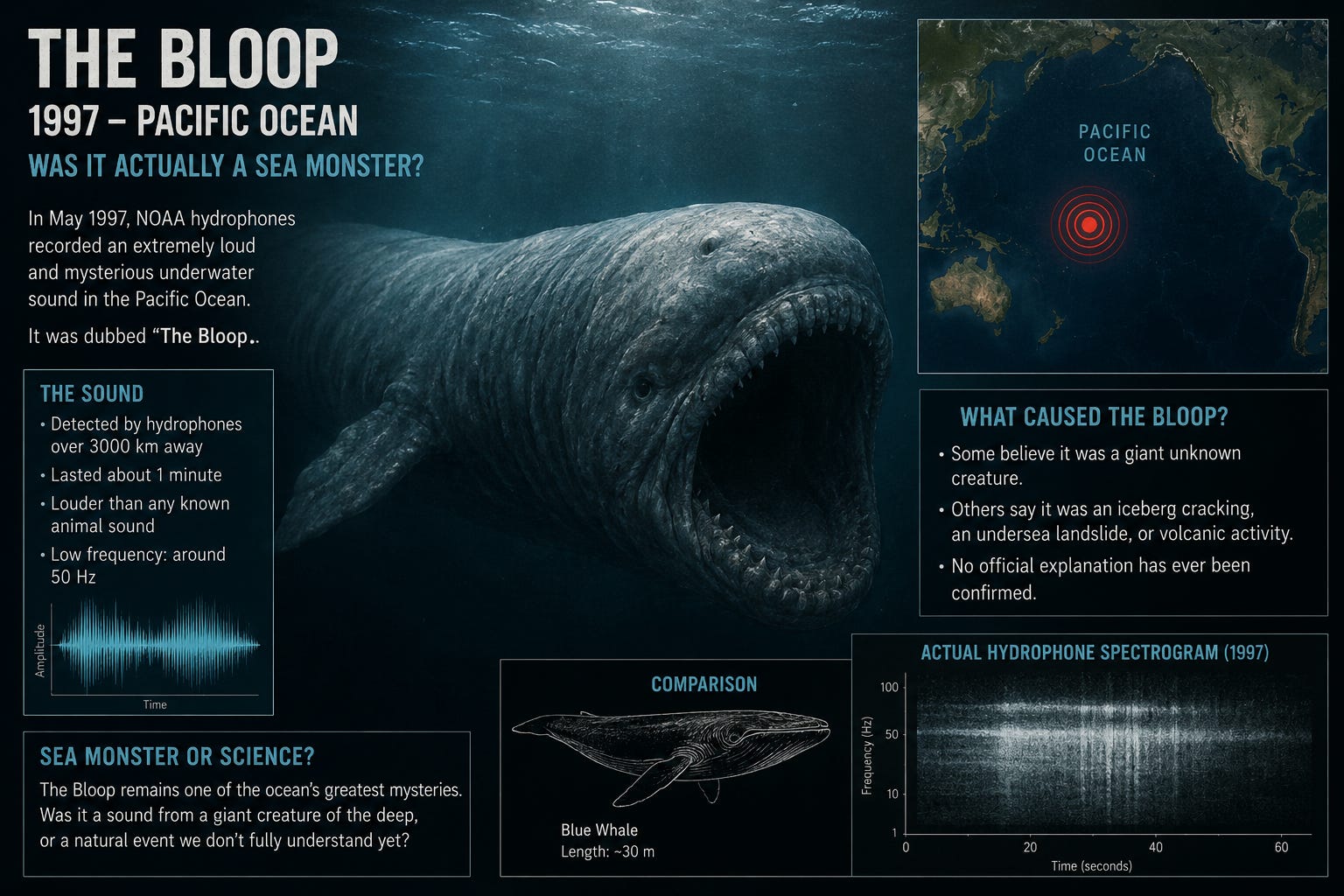
In the summer of 1997, hydrophone arrays originally built by the U.S. Navy to track Soviet submarines during the Cold War, and later repurposed by the National Oceanic and Atmospheric Administration to monitor undersea seismic and volcanic activity, picked up an extremely powerful, ultra-low-frequency sound. Researchers nicknamed it “the Bloop.” The signal was strong enough to register on sensors more than 5,000 kilometers apart, tracing back to a point in the South Pacific far from any known landmass.
A sound too loud for any known animal
When NOAA scientists first analyzed the recording, its amplitude appeared to far exceed anything produced by the loudest known animal, the blue whale, even after accounting for how sound travels through deep water. The sound’s rapid pitch fluctuation didn’t closely match any cataloged marine mammal call either. The gap between the evidence and a tidy answer was enough to draw wide public attention: news outlets speculated about an undiscovered sea creature, and some commentators noted the sound’s origin point was roughly near the fictional location of H.P. Lovecraft’s sunken city of R’lyeh, home to the monster Cthulhu, adding a layer of pop-culture myth to an already strange data point.
The iceberg explanation
By the mid-2000s, NOAA acousticians had collected years of additional recordings from the same hydrophone network and begun comparing the Bloop’s spectrogram against a growing library of known cryoseismic events. In 2005, researchers matched its signature to the kind of sound produced by large icequakes: the cracking and fracturing of enormous icebergs as they calve away from Antarctic ice shelves and grind against the seafloor or each other. Several similar, if less dramatic, signals recorded in the same years were traced to icebergs whose locations and timing were independently confirmed, effectively ruling out a biological or artificial source. Even after being explained, the Bloop remains one of the most widely cited examples of how an ordinary geophysical process can, at first glance, look inexplicable.
SOURCES
— NOAA Pacific Marine Environmental Laboratory, Acoustics Program, “The Bloop” technical summary
— Dziak, R. et al. “Large-scale ice fracture and calving events recorded on the equatorial Pacific hydrophone array,” Journal of Geophysical Research (2005 findings, published summary)
— NOAA Ocean Explorer, hydrophone monitoring program archives