

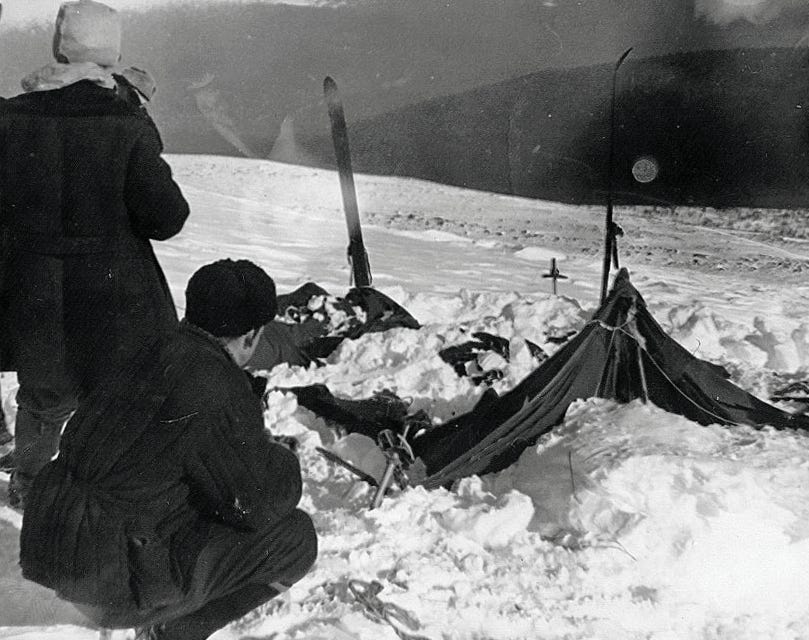
In late January 1959, ten students and recent graduates from the Ural Polytechnic Institute set out on a ski-trekking expedition toward Gora Otorten, a mountain in the northern Urals. One member turned back early due to illness. The remaining nine, led by Igor Dyatlov, pitched camp on the slope of a peak the local Mansi people called Kholat Syakhl roughly translated as “Dead Mountain.” They were never seen alive again.
What the search party found
When the group missed its check-in date, a search was launched. Searchers found the tent partially collapsed and slashed open from the inside, with boots, coats, and supplies left behind as though the campers had fled into subzero temperatures without proper clothing. Footprints, some in socks or bare feet, led downhill toward a treeline more than a kilometer away.
The first two bodies were found near the remains of a small fire beneath a cedar tree, its lower branches broken as if someone had climbed it to see farther across the slope. Three more bodies were discovered between the tree and the tent, apparently having tried to return. The final four were not located until May, buried under snow in a ravine, and showed the most severe injuries: crushed ribs, a fractured skull, and one victim missing her tongue and eyes. None of the injuries were consistent with an attack by another person, according to the original 1959 investigation, which closed the case citing an unknown “compelling natural force.”
Decades of competing theories
The gap between the physical evidence and a clean explanation fueled decades of speculation a secret weapons test, infrasound-induced panic, a Mansi tribal attack, even claims of a cover-up tied to Soviet military exercises. Katabatic winds, paradoxical undressing associated with hypothermia, and animal scavenging have all been proposed as partial explanations for specific details.
In 2019, Russian authorities reopened the case, and a 2021 study led by Swiss researchers modeled a small, delayed slab avalanche combined with the specific slope geometry and a buried snowmobile-style vehicle used for shelter, arguing it could produce the blunt-force injuries without leaving an obvious avalanche scar. The theory has been influential but is not universally accepted, and the case remains, for many researchers, a rare instance where the physical evidence outpaces any single tidy narrative.
SOURCES