

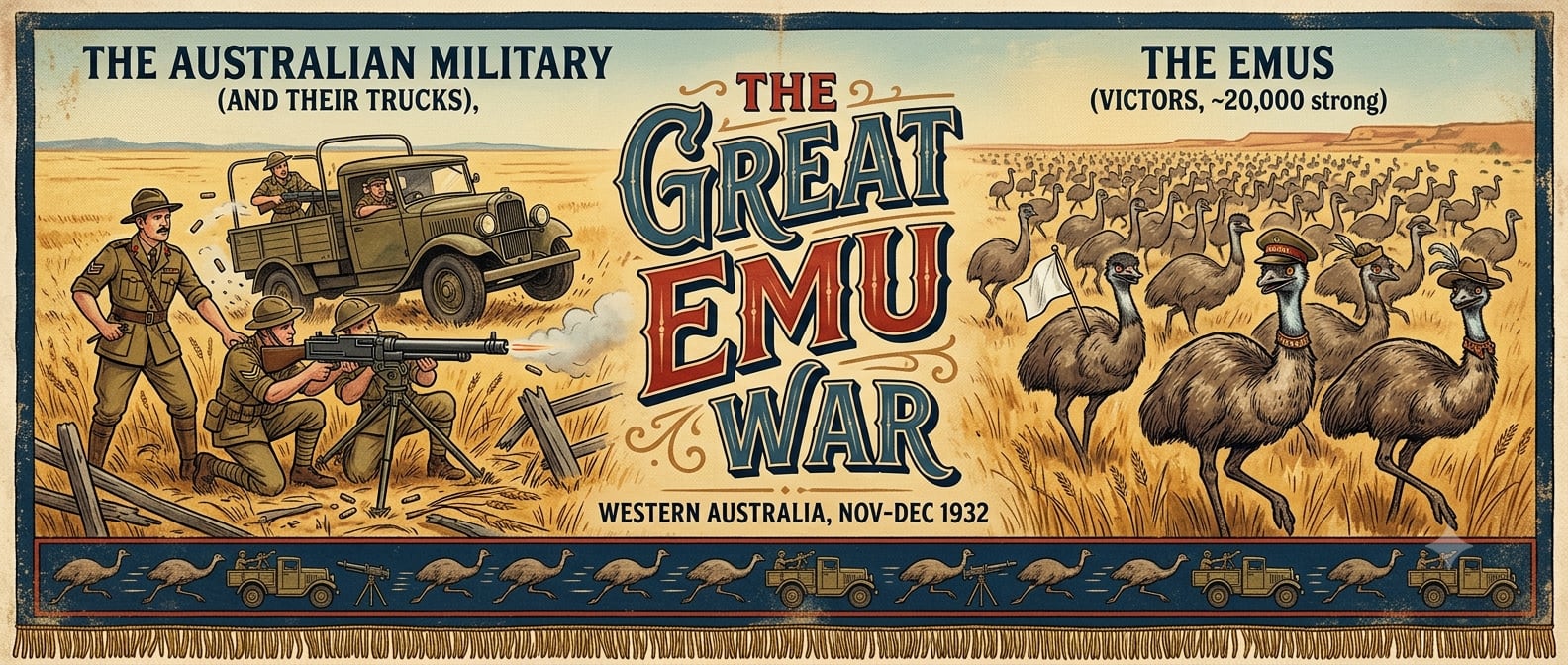
After World War I, the Australian government resettled thousands of veterans as farmers in Western Australia, promising subsidies that mostly failed to materialize before the Great Depression hit wheat prices hard. Compounding the farmers’ troubles, some 20,000 emus migrating inland after their breeding season descended on the wheat belt around Campion, trampling crops and tearing through fences as they went.
Sending in the artillery
Farmers petitioned the government for military assistance, and Defence Minister George Pearce agreed to deploy soldiers armed with two Lewis machine guns, framing it partly as useful marksmanship practice. Major G.P.W. Meredith led the operation, which began in early November 1932.
The results were immediately unimpressive. Emus proved fast, erratic, and hard to hit in open formation, scattering the moment gunfire started rather than bunching into an easy target. In one widely cited incident, a machine gun jammed after only a handful of birds were downed. Meredith later compared the emus’ ability to absorb hits and keep running to tanks.
A quiet withdrawal
After roughly a month and thousands of rounds fired, military estimates of confirmed emu kills ranged from the low hundreds to under a thousand, out of tens of thousands of birds in the area — a poor return that led to the operation’s quiet suspension. The “war” became a minor embarrassment in the Australian press and later a recurring piece of internet folklore, though farmers were subsequently granted ammunition and bounty schemes to handle the birds themselves, which proved considerably more effective.
SOURCES
— Johnson, M. “Feathered Foes: Soldier Settlers and Western Australia’s ‘Emu War’ of 1932,” Journal of Australian Studies (2006)
— National Archives of Australia, Department of Defence correspondence, 1932
— Australian War Memorial, official unit records, 7th Heavy Battery