

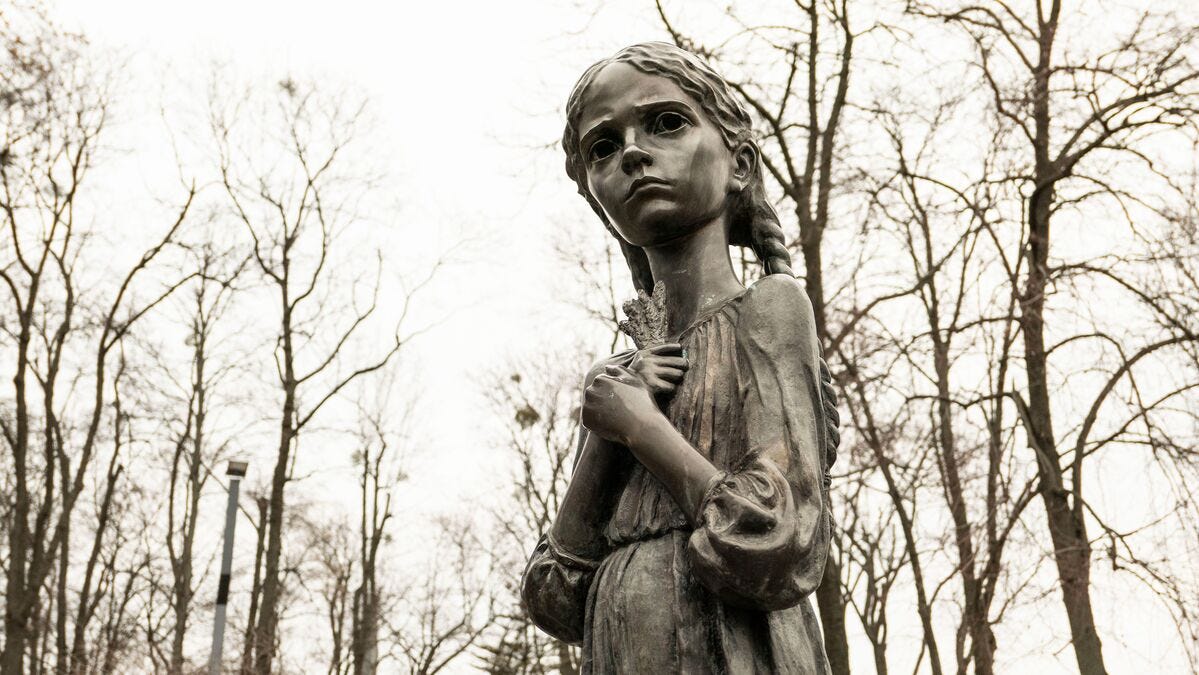
In the late autumn of 1932, the fertile black soil of Ukraine a landscape historically celebrated as the ‘breadbasket of Europe’ became the setting for one of the most calculated acts of state-sponsored devastation in human history. Under the absolute authority of Joseph Stalin, the Soviet regime engineered a man-made famine known today as the Holodomor (derived from the Ukrainian words for ‘to kill by starvation’). This catastrophe was not born of drought, crop disease, or natural atmospheric failure. It was a cold, deliberate administrative exercise in structural destruction, designed specifically to break the backbone of Ukrainian nationalism, eliminate the independent peasantry (’kulaks’), and force the remaining population into total submission to centralized collective state farms.
The Legal Framework of Hunger
The tragedy accelerated rapidly following the introduction of impossibly high grain requisition quotas imposed by Moscow. When individual villages naturally failed to meet these unrealistic targets, the state did not offer relief; instead, it enacted the brutal ‘Law of Five Ears of Grain’ on August 7, 1932. Under this decree, anyone including starving children caught gathering leftover stalks of wheat from harvested state fields could be executed on the spot or sentenced to ten years in forced labor camps. To ensure absolute compliance, the Soviet state deployed specialized activist brigades. These urban communist squads systematically swept through rural villages, utilizing iron rods to probe the earth, walls, and chimneys for hidden jars of grain or flour. They did not just confiscate agricultural surpluses; they stripped households of vegetables, livestock, and any edible material, leaving communities completely devoid of sustenance.
Simultaneously, the regime implemented a highly restrictive internal passport system. This effectively cordoned off the Ukrainian border, preventing starving peasants from fleeing to neighboring regions or urban centers in search of bread. Villages that failed to meet their quotas were placed on ‘blacklists.’ This status suspended all local commerce, prohibited the import of manufactured goods, and blocked any external food supply from entering. Trapped within their own borders, millions of people were forced to consume grass, tree bark, and domestic animals as the social fabric completely unraveled under the weight of desperate survival.
The Global Cover-Up and Media Gaslighting
As the death toll climbed into the millions, the Soviet state maintained an ironclad international blackout. Foreign journalists were strictly banned from traveling to the affected rural areas, and official documentation was systematically altered. In Moscow, Western reporters who wished to maintain their credentials actively self-censored. Most notoriously, Walter Duranty, the Moscow Bureau Chief for The New York Times, actively dismissed reports of famine, famously writing that ‘any report of a famine in Russia is today an exaggeration or malignant propaganda.’ Duranty’s highly deceptive reporting earned him a Pulitzer Prize, while independent journalists like Gareth Jones, who risked their lives to slip into Ukraine and expose the truth, were publicly discredited and marginalized.
The true scale of the Holodomor remained hidden for decades. Census data from 1937 that revealed a massive, unexplainable population deficit was suppressed by the regime, and the demographers who compiled it were executed. Only after the collapse of the Soviet Union and the subsequent opening of secret state archives did the true structural horror come fully to light, cementing the Holodomor as a stark historical warning of how totalitarian governance can manipulate basic human needs into an absolute weapon of mass destruction.
Sources
National Museum of the Holodomor-Genocide (Kyiv, Ukraine): https://holodomortour.ca/educational-hub/resources-and-archival-material/
Jones, Gareth, and Lubomyr Y. Luciuk (Eds.). “Tell Them We Are Starving”: The 1933 Diaries of Gareth Jones. Kingston, Ont.: Kashtan Press, 2015.