

Somewhere in the frozen chemistry of the outer solar system, a molecule is hiding. Using the James Webb Space Telescope, an international team of astronomers has detected a distinct fingerprint of light absorption on the surface of Saturn’s giant moon Titan and then found the same strange signature on distant Pluto.
It matches no known compound in any laboratory or astronomical catalog. For now, the substance responsible remains a mystery, one written into the surfaces of two of the most intriguing icy worlds we know.
The discovery, led by Bruno Bézard of the Paris Observatory with sixteen colleagues, appears in a paper submitted to Astronomy and Astrophysics and posted to the arXiv preprint server in June 2026. It grew out of an effort to do something notoriously difficult, which is to see the ground of Titan at all.
Peering through Titan’s haze
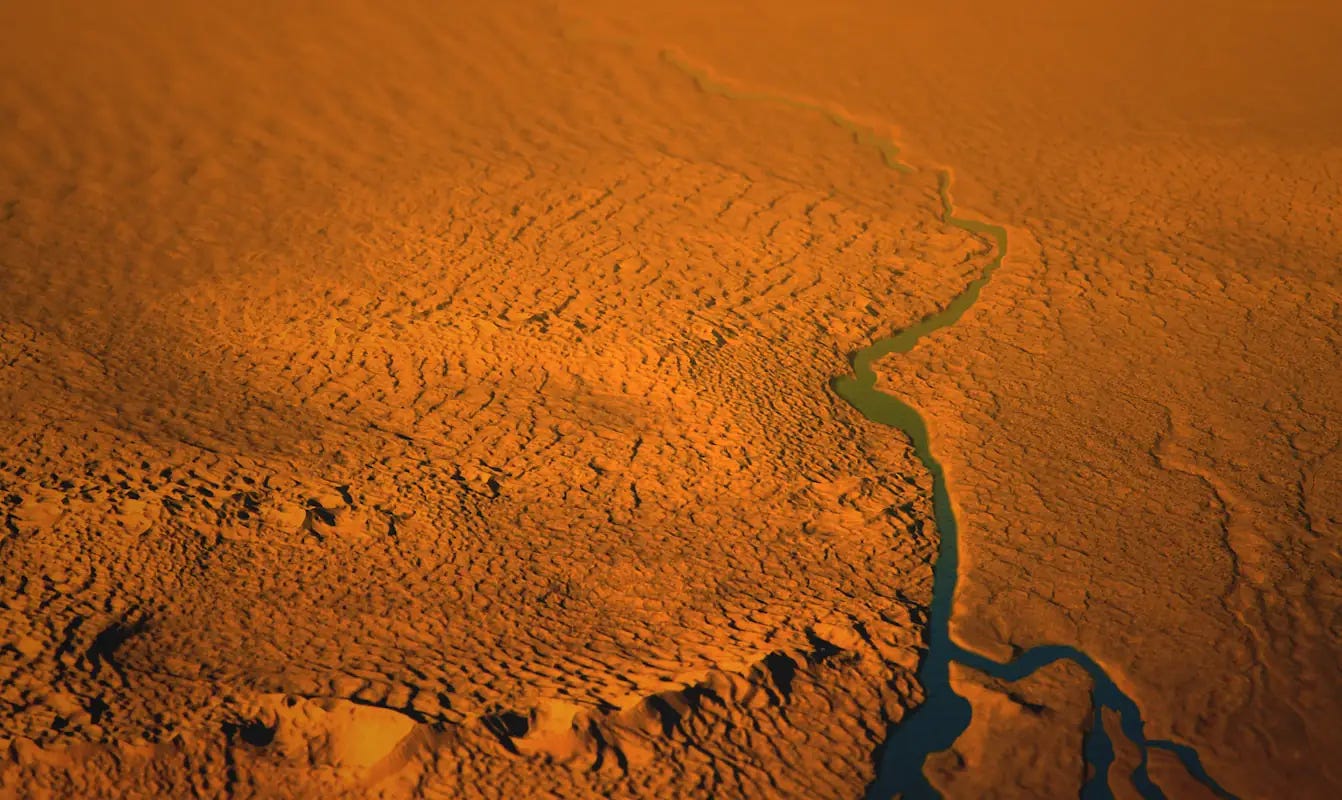
Titan is wrapped in a thick atmosphere of nitrogen and methane, blanketed by an orange organic haze that hides its surface from most instruments. That veil has kept the chemical makeup of Titan’s solid ground deeply uncertain. To get around it, the team exploited a relatively clear atmospheric window near 5 micrometers in the infrared, a stretch of the spectrum where the haze is thinner and where JWST’s sensitivity and broad reach could pick out faint signals from the ground below.
Sifting through spectra from two of Webb’s instruments, NIRSpec and MIRI, the researchers found an unexpected feature. Centered at a wavelength of 5.113 micrometers, it dipped the light by about 6 to 7 percent on Titan, a clear and repeatable absorption. The trouble was that nothing in their models produced it. When they compared the observation against a detailed radiative transfer simulation containing every known gas and haze particle, the dip simply was not there in the synthetic spectrum. It could not be explained by leftover methane, and its shape, broad and smooth rather than the sharp spike of a typical gas absorption, did not look atmospheric at all.
Confirming it comes from the ground
Because a false signal could in principle arise from the atmosphere, the team ran a careful check. They compared the spectrum at the center of Titan’s disk, where sunlight passes through less air on its way to and from the surface, with the spectrum toward the moon’s edges, where the atmospheric path is longer. The behavior of the feature pointed to an origin on the surface itself rather than in the gas above it. In other words, whatever is producing the absorption is a material lying on Titan’s ground.
The same signature on Pluto
The most tantalizing turn came when the team looked at Pluto, which has its own thin, Titan-like atmosphere. In Webb’s MIRI spectrum of the dwarf planet, they found a comparable absorption, roughly 4 to 5 percent deep, though somewhat broader than the one on Titan. Finding the same unexplained signature on two separate worlds strongly suggests that a single compound, or a family of closely related compounds, is present on both. That the substance appears across such different and widely separated bodies makes it more interesting still, hinting at some shared piece of outer solar system chemistry that has so far escaped identification.
Searching the catalogs and coming up empty
The researchers did not stop at declaring a mystery. They combed through published laboratory spectra of the ices expected to form on Titan from the condensation of its atmospheric hydrocarbons and nitrogen compounds, and none of them reproduced the 5.11-micrometer band. As Bézard put it, the team examined many simple ices that ought to be present, and they do not match. The paper does offer a handful of plausible candidate materials worth testing further, but it stops well short of a firm answer. The honest conclusion is that the compound is, for now, unidentified.
Waiting on Dragonfly and new data
Two paths forward could crack the case. First, the team plans to map the absorption across Titan’s entire disk using a fuller set of JWST observations, which may reveal where on the moon the material concentrates and offer clues to how it forms. Second, NASA’s Dragonfly mission, a rotorcraft due to reach Titan in the mid-2030s, will study surface composition directly at several sites. Its onboard instrument, the Dragonfly Mass Spectrometer, could in principle detect some of the candidate compounds. The authors note an important catch, however. Because Dragonfly carries no infrared spectrometer, it will not be able to observe the 5.11-micrometer feature itself, only to sample the materials and hope one of them proves to be the culprit.
Until then, the substance keeps its secret. Two cold and distant worlds, a moon of Saturn and a dwarf planet at the solar system’s edge, share a chemical signature that no one on Earth has yet managed to name.
Source. B. Bézard, E. Lellouch, et al. (2026), "An unidentified absorption feature at 5.11 μm on the surface of Titan and Pluto from JWST spectroscopy," arXiv:2606.13350, doi.org/10.48550/arXiv.2606.13350.
Never mind molecules…🤣✨Seeing ain’t believing anymore…? Like for instance a slug 🐌 that’s almost as big as football stadium …? Real as it is hard to imagine in this our age of denial….? Only bonafide PhDs and scientists need apply …? Pluto , as we call it, is one of the most active, geologically speaking, planets in our entire solar system besides us…that is…? Nothing to see or discover here except rock hard ice🔮👀✨?❔❓🙏🏼