

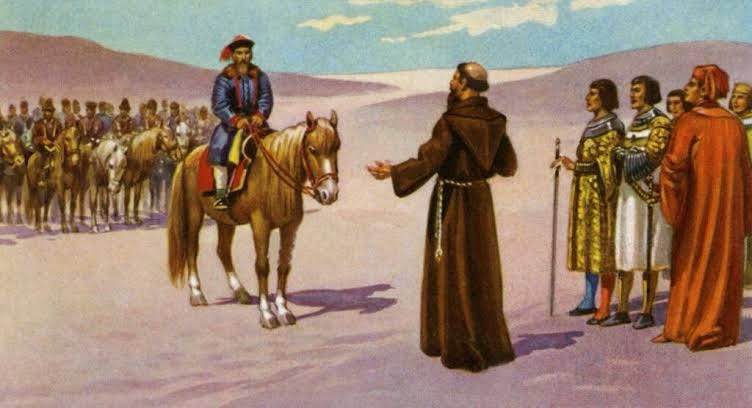
The remarkable journey of John of Plano Carpini (Giovanni da Pian del Carpine) stands as one of the most daring diplomatic missions in medieval history. Long before Marco Polo set foot in China, this elderly Franciscan friar traveled thousands of miles into the heart of the Mongol Empire to deliver a letter to the Great Khan.
1. The Context: A Terrified Europe
In the early 1240s, the Mongol armies under Batu Khan swept through Eastern Europe, devastating Poland and Hungary. Western Europe braced for an apocalypse, but the Mongol forces suddenly withdrew in 1242. Unbeknownst to the Europeans, this retreat was triggered by the death of the Great Khan, Ögedei; the Mongol commanders needed to return to their capital, Karakorum, to elect a new leader.
Seeking to understand this terrifying new power and stop future invasions, Pope Innocent IV decided to send envoys. He chose Friar John of Plano Carpini, a companion of St. Francis of Assisi. Carpini was 63 years old an advanced age for the time”and quite corpulent, meaning he had to ride a donkey or horse across brutal terrain for months on end.
2. The Epic Journey (1245–1246)
Carpini set out from Lyon, France, on Easter Sunday in 1245. Traveling through Germany, Poland, and Kyiv, he reached the Mongol-controlled steppes of the Golden Horde by early 1246.
From the banks of the Volga River, Carpini and his companion, Friar Benedict the Pole, were forced into a relentless, high-speed ride across Asia. Utilizing the highly efficient Mongol Yam (postal relay system), they changed horses several times a day, riding up to 100 miles daily through extreme weather and starvation diets.
By July 1246, they reached the imperial camp near Karakorum, just in time for a historic event: the enthronement of Güyük Khan, the grandson of Genghis Khan.
3. The Meeting with Güyük Khan
Carpini was among the first Europeans to witness the stunning grandeur of the Mongol court. He documented the assembly of thousands of ambassadors, princes, and elites gathered at the Syra Orda (the Yellow Tent).
When Carpini finally secured an audience with the newly crowned Güyük Khan, he presented Pope Innocent IV’s papal bulls. The Pope’s letters demanded that the Mongols cease attacking Christians and suggested that the Khan convert to Christianity.
The Khan's Defiant Ultimatum
Güyük Khan was thoroughly unimpressed by the Pope's demands. The Mongol world view was absolute: the Eternal Blue Sky (Tengri) had mandated Genghis Khan and his descendants to rule the entire earth. Güyük issued a famous, uncompromising written response to the Pope:
"You must say with a sincere heart: 'We will be your subjects; we will give you our strength.' You must come together with your kings, all without exception, to render us service and homage. Only then will we accept your submission. And if you do not follow the order of God, and go against our orders, we will know you as our enemies."
4. Key Takeaways & Impact
Though Carpini failed to convert the Khan or secure a peace treaty, his mission changed history in several critical ways:
The First Real Intelligence report on East Asia: Upon his return to Europe in 1247, Carpini wrote the Ystoria Mongalorum (History of the Mongols). It provided Europe with its first accurate, objective look at Mongol military tactics, culture, diet, and governance, shattering previous myths about "monsters" from the East.
The Papal Letter Preservation: The original letter from Güyük Khan to Pope Innocent IV, sealed with the imperial Mongol seal in Old Turkish and Persian, survived and was rediscovered in the Vatican Archives in 1920.
The Blueprint for Future Travelers: Carpini's detailed roadmap proved that overland travel across Eurasia was possible under the Pax Mongolica (Mongol Peace), paving the way for later explorers like William of Rubruck and Marco Polo.
Souces
John of Plano Carpini, Ystoria Mongalorum (History of the Mongols)