

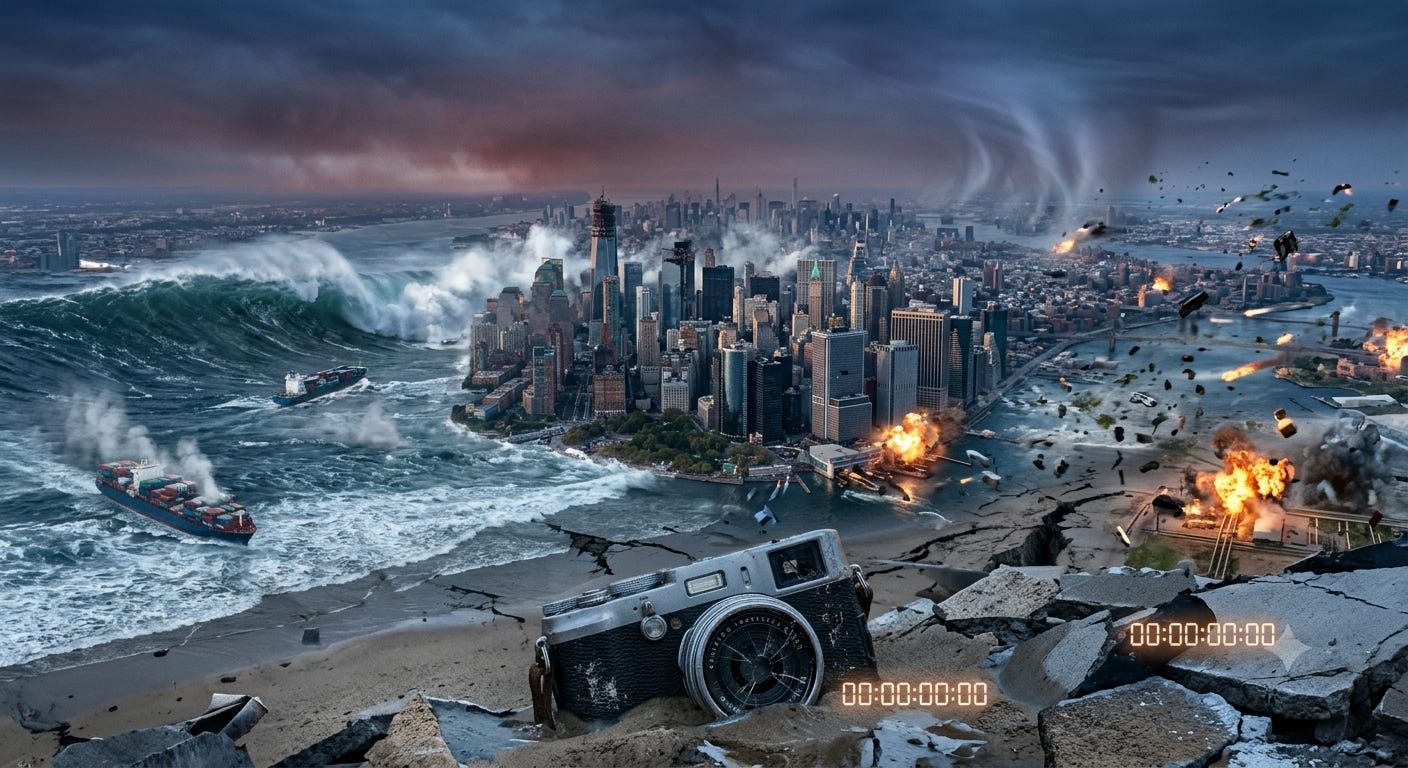
A one-second pause doesn’t sound like much, does it? A hiccup. A breath. But if Earth decided to take a one-second break from its relentless rotation, that single moment would reshape the world.
To understand why, you have to understand momentum. Right now, as you sit reading this, you are not actually still. Unless you are near the poles, you are barreling eastward at roughly 1,000 miles per hour (1,600 km/h). Earth spins, and because of inertia, everything on the Earth—you, the atmosphere, the oceans, the buildings—is moving with it.
If Earth stops, that inertia doesn’t. And the results would be catastrophic.
The Winds of Armageddon
The moment Earth halted, the atmosphere would keep moving at 1,000 mph. We tend to think of ‘air’ as light, but a supersonic wall of air moving across the planet is the ultimate destructive force.
This instantly triggers a global supersonic windstorm. Forget hurricanes; this wind would be fast enough to rip the bedrock from the ground. This would not be a gradual increase in wind speed; it would be instant, devastating force, moving faster than sound. It would instantly level every forest, pulverize buildings, and launch everything not securely anchored to the crust (and many things that are) eastward.
Ocean Surge
The oceans, containing 97% of Earth’s water, also have inertia. As the lithosphere stopped beneath them, the water would keep rushing eastward. A colossal, continent-sized tidal wave would bulge and accelerate across every ocean basin.
It wouldn’t be a single tsunami. It would be an entire ocean displacing itself. These waves, potentially miles high, would crash onto every eastern coastline around the globe, traveling hundreds of miles inland, sweeping away entire major cities and completely rewriting the map. The Atlantic and Pacific would, briefly, overtop the continents.
A Twisted Planet
Earth itself is slightly flexible. Its rapid spin makes it bulge slightly at the equator (it’s an oblate spheroid, not a perfect sphere). Stopping the spin removes the centrifugal force causing that bulge. In that one second, the Earth’s crust would attempt to snap back into a more perfect sphere. This would trigger unprecedented global earthquakes and volcanic eruptions. The entire planet’s surface would, effectively, be wrung out like a sponge.
The Aftermath: If it Starts Again
The prompt says it stops for “just one second.” So, what if, after that second of annihilation, the Earth starts spinning again?
This is where things get truly apocalyptic.
To resume its original rotation speed instantly would require another massive input of energy, effectively acting as another deceleration event. Anything that somehow survived the first supersonic windstorm would be hit by a second one, likely moving in a complex, chaotic direction as the atmosphere struggled to catch up with the spinning ground.
The initial global seismic event (the crust flattening) would be followed by a massive global seismic torque re-establishing the equatorial bulge. The earthquakes would escalate from “catastrophic” to “surface-rendering.” The atmosphere would become a turbulent, opaque shroud of dust and vapor, blocking out the sun for months.
A Second to End It All
If Earth stopped for just one second, humanity as we know it would cease to exist. The energy required to stop and then restart the planet’s spin is incomprehensible. The kinetic energy released would likely liquefy large portions of the crust. The remaining atmosphere would be lost to space, blown away by the supersonic winds. Earth would transform from a vibrant blue marble into a scarred, silent rock, the ultimate testament to the power of inertia and the delicate balance of planetary dynamics. We live, truly, on a knife’s edge of momentum.