

The Vikings were, if nothing else, formidable travellers. Setting out from their Scandinavian homeland, they reached as far south as Spain, crossed the open Atlantic to Canada, and pushed east toward the Middle East. They also settled Greenland, and lived there successfully for more than four hundred years, before eventually abandoning it. For a long time, no one knew exactly why.
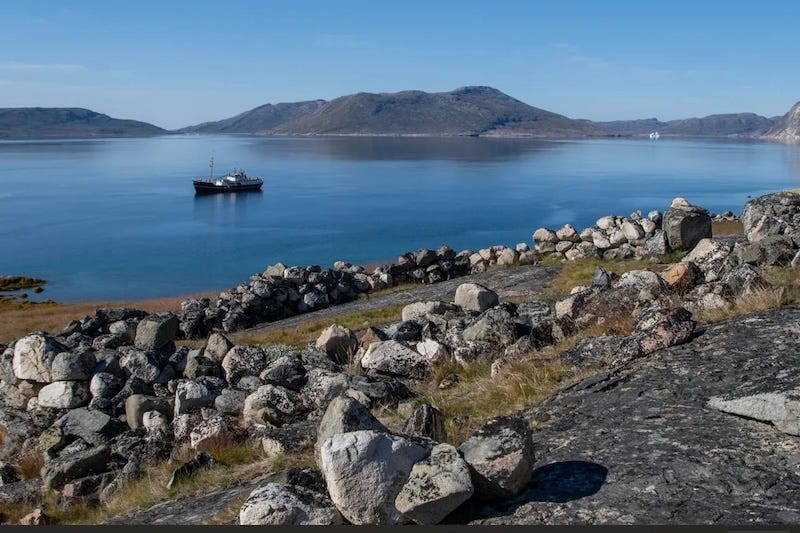
The Hvalsey farm in Greenland’s Qaqortukulooq region is home to some of the best-preserved Norse ruins in the Eastern Settlement, offering a remarkable glimpse into the lives of Greenland’s medieval settlers.
A study published in Science Advances in 2022, still cited as the clearest answer to the question, found that the real explanation was not what most people had assumed.
Norse settlers founded the Eastern Settlement in southern Greenland around the year 985 AD. By the early fifteenth century, it had been largely abandoned. As the study’s authors note, earlier research had already suggested the departure likely stemmed from multiple compounding problems, climate change, failures of governance, economic collapse, or social stratification among them, since southern Greenland had always sat at the very margin of what could be farmed at all.
The cold explanation that made sense, until it didn’t
For years, the most widely accepted theory held that the Norse settlers simply could no longer endure the cold. This was never a knock on Viking toughness. The world genuinely had grown colder, since the planet was entering the period now known as the Little Ice Age, and the shift was no small matter of thicker coats or an extra log on the fire. A roughly two-degree Celsius drop in temperature triggered serious disruption on a global scale. Rivers and coastal seas froze over, bringing trade and communication to a standstill, while torrential rains ruined harvests and killed off crops and livestock, producing widespread famine and hardship.
Greenland is not exactly known for blistering summers even today, so it made intuitive sense that the Little Ice Age would have been what finally ended farming on this already inhospitable, ice-bound land. Geological evidence, including ice core records used to reconstruct centuries of temperature change across Greenland, seemed to back the theory up. It looked like an open-and-shut case.
There was just one problem. As study co-author Raymond Bradley explained, no data existed from the actual location of the Norse settlements themselves before this research, and that gap in the evidence was a real problem. The existing ice core evidence did show Greenland turning too cold for agriculture during the Little Ice Age, but it came from a region many thousands of kilometers away from where the Vikings had actually settled. Bradley and his colleagues wanted to examine how the climate had changed specifically near the Norse farms themselves.
The real culprit was not temperature
That is where the surprises began. No suitable ice core existed near the original Norse settlement sites, but the team found something nearly as good, a small, unassumingly named body of water called Lake 578, sitting just nine kilometers from the tiny village of Qassiarsuk. Today Qassiarsuk is genuinely tiny, with a population of just 39 people as of 2020. A thousand years ago, however, this same spot was known as Brattahlíð, home to the Viking explorer Erik the Red and to some of the largest farms in all of Norse Greenland, making it the ideal place to study exactly how conditions changed for the Norse settlers, and perhaps finally explain why they left.
Nobody had ever studied this particular location before, said Boyang Zhao, the study’s lead author, who carried out the research for his doctoral degree in geosciences at the University of Massachusetts Amherst. Zhao and his colleagues spent three years collecting sediment samples from the lake, aiming to reconstruct roughly 2,000 years of local temperature and water availability using chemical markers preserved in the layered sediment.
What we discovered, Zhao said, is that while temperature barely changed at all throughout the entire period of Norse settlement in southern Greenland, the region grew steadily and increasingly dry over time.
That growing dryness would have been devastating for Greenland’s Vikings, since farming there was extraordinarily difficult even in good years. During the winter months, cattle and some sheep and goats had to be kept in dark barns, and by the time spring finally arrived, many cattle were too weak to walk on their own, forcing Norse farmers to physically carry the animals out to pasture.
Under drought conditions, this already precarious system collapsed outright. Less rainfall meant lower crop yields, which in turn meant farmers could no longer feed their livestock through the winter months at all.
The end of a culture
Some turned to the sea for food, hunting marine mammals in place of the livestock they could no longer raise on land. But that was a far riskier undertaking than farming had ever been, and there was never any guarantee that a hunt would actually succeed. As food grew increasingly scarce and unreliable, expanding sea ice simultaneously threatened to cut the settlers off entirely from mainland Europe. According to the study, these combined pressures made the eventual fate of Norse Greenland close to inevitable.
Unable to adapt to an increasingly dry environment, the settlers faced growing social instability, and eventually abandoned their homes altogether, migrating toward regions that were not necessarily warmer, but were at least wetter.
The research closes with a carefully qualified conclusion. The reasons behind the abandonment of the Norse settlements are complex, the authors write, and it would be wrong to attribute it to climate change alone. Even so, their results clearly show that shifts in hydroclimate were closely tied to the fate of the Eastern Settlement.
Sources. IFLScience (June 25, 2026); Forbes; ZME Science; Polar Journal. Zhao, B., Castañeda, I.S., Salacup, J.M., Thomas, E.K., Daniels, W.C., Schneider, T., de Wet, G.A., and Bradley, R.S. (2022). “Prolonged Drying Trend Coincident With the Demise of Norse Settlement in Southern Greenland.” Science Advances 8(12), eabm4346. doi.org/10.1126/sciadv.abm4346
there are different theories. As well hostile inuits could have influences. There are told stories in their cultures about confrontations