

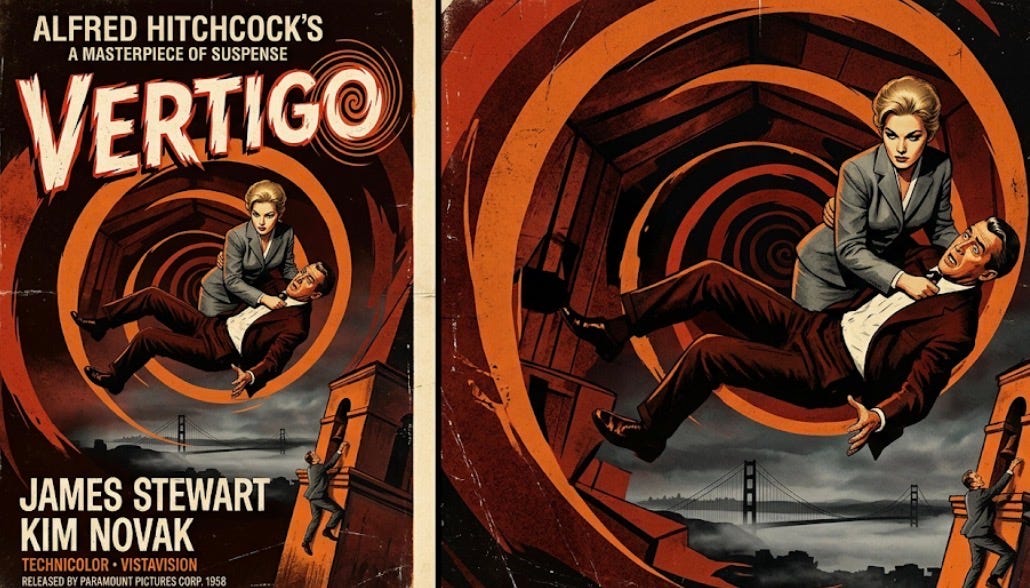
When audiences first watch Alfred Hitchcock’s Vertigo, they believe they are seeing a mystery unfold through the eyes of former detective Scottie Ferguson. They follow his confusion, his growing love for the mysterious Madeleine, and his devastating loss. The film feels like a psychological thriller with an unexpected twist.
But on a second viewing, Vertigo becomes a completely different film.
Once you know that Madeleine is actually Judy Barton playing a carefully constructed role in a murder plot, every scene changes. What first appeared mysterious now reveals itself as an extraordinary performance both by Judy and by Hitchcock himself.
One of the first things you’ll notice is that Judy is almost always aware of Scottie’s gaze.
Every glance over her shoulder, every carefully timed pause, every movement through the streets of San Francisco is no longer accidental. She is making sure Scottie is following her exactly as planned. The audience initially mistakes these moments for romance or coincidence, but in reality they are part of an elaborate performance designed to manipulate him.
The famous museum scene is one of the clearest examples. Madeleine appears hypnotized by the portrait of Carlotta Valdes, as though possessed by another woman’s spirit. On a second viewing, however, you realize she is not lost in a trance she is acting for Scottie, knowing he is watching every movement.
The staged rescue from San Francisco Bay works the same way. During the first viewing, Scottie appears to save Madeleine from suicide. Later, we understand that this was carefully orchestrated to create intimacy and trust between them. Scottie believes he is the hero, while in reality he is being drawn deeper into a carefully designed illusion.
This is where Hitchcock introduces one of the film’s central ideas: the power of the gaze.
Scottie is constantly looking at Madeleine, believing he is discovering the truth about her. In reality, he only sees what others have chosen for him to see. His gaze is not objective—it is manipulated. Hitchcock quietly reminds us that audiences are no different. Just as Scottie is captivated by Madeleine, we too are captivated by the story Hitchcock presents, accepting illusion as reality.
The film then shifts after Madeleine’s apparent death. Judy returns as herself, and Hitchcock makes a remarkable storytelling decision by revealing her identity to the audience long before Scottie discovers it. The mystery disappears, replaced by tragedy.
Now every scene is filled with tension.
Judy loves Scottie, yet she knows that if he discovers the truth, she will lose him forever. Every smile hides guilt. Every silence hides fear. The audience watches helplessly as Scottie unknowingly falls in love with an illusion that no longer exists.
What follows is perhaps the film’s most disturbing transformation.
Scottie does not fall in love with Judy. Instead, he slowly erases her identity, forcing her to recreate Madeleine changing her clothes, her hairstyle, her hair color, and even the way she carries herself. He is no longer trying to recover the woman he loved; he is trying to resurrect a fantasy.
This is why many critics see Vertigo as one of cinema’s earliest and most powerful explorations of the male gaze. Scottie does not accept Judy for who she is. He loves an image, not a person. Judy sacrifices her own identity because she genuinely loves him, making her the film’s true tragic figure.
Throughout the film, Hitchcock reinforces these ideas through visual symbolism. The recurring spiral represents obsession and the endless cycle Scottie cannot escape. The eerie green light surrounding Judy after her transformation suggests the impossible resurrection of a ghost. The bell tower symbolizes fear, truth, and the confrontation Scottie spends the entire film avoiding.
The ending is devastating because Scottie finally overcomes his vertigo at the exact moment everything is lost. He reaches the top of the tower, learns the truth, and conquers his fear but only after Judy falls to her death. His victory comes too late.
This is why Vertigo is considered one of the greatest films ever made. It is not simply a mystery about deception or a thriller about murder. It is a meditation on obsession, identity, illusion, grief, and the dangerous desire to remake another person into an ideal.
The first viewing asks, “What happened?”
The second viewing asks something far more unsettling:
“How much of what we see is real, and how much is simply the story we want to believe?”
That is Hitchcock’s greatest trick. Scottie spends the entire film watching Judy, believing he understands her. On a second viewing, we realize Judy has been watching Scottie just as carefully all along.